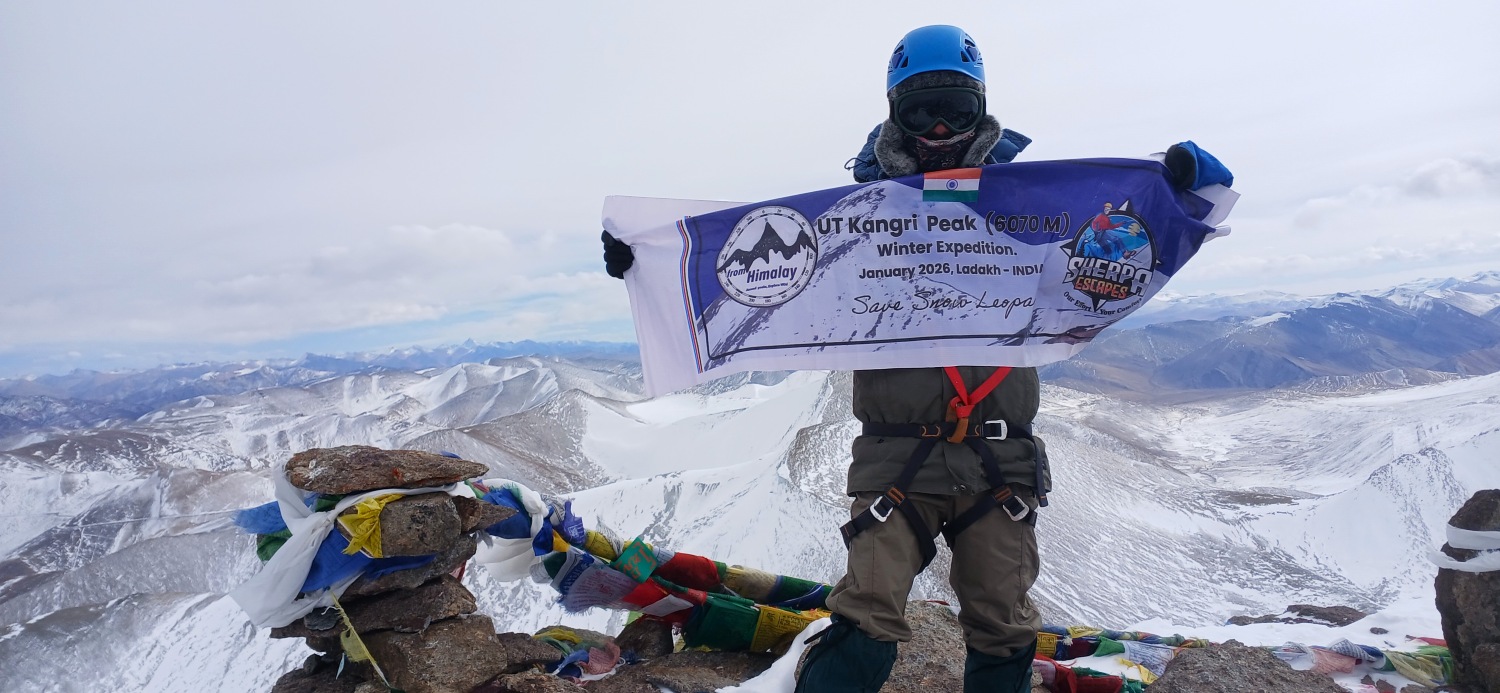

Six Mountaineers on a mission to survive at -38° and winter Ascent of Mt. UT Kangri 6070M in Ladakh Himalayas | Mt. UT Kangri Winter Expedition Jan 2026
Hi everyone! I’m Virendra Singh. I hail from the Garhwal Himalayas and live for exploring and photography. I’m writing about my latest expedition experience on MT. UT Kangri (6070 M) in Ladakh Himalay. last month on the same day 22-Jan-2026 i summited the peak with amazing team of Sherpa Escapes and from Himalay honestly, it felt like living in a documentary! I wanted to write this down so you could get a real taste of what mountaineering is like—and if you’re a climber yourself, you definitely want to read this. This was my first winter expedition, and the adrenaline was off the charts. If you have a passion for the peaks, dive into the article below, You can check out the expedition row footage Youtube video attached, Let’s get started!
Short Summary – This was a Joint Expedition under Sherpa Escapes as often do treks and expedition together, our Journey began on 17th January with our arrival in Leh, followed by two days of rest and acclimatisation. As the weather window started turning harsh, we moved to Rumtse village (4,500 m) on 19th January. On 20th January, we advanced to Advance Camp, where the cold had already tightened its grip. On 21st January, we acclimatised, prepared, and mentally geared up for a night summit push. Everyone was healthy, steady, and focused. At 3:30 AM on 22nd January, we began our summit push from Advance Camp. By 3:00 AM, we reached the crampon point. As daylight broke, fierce winds followed-sharp snow striking our faces, the cold deepening with every step. The higher we climbed, the harsher the conditions became. Despite temperatures dropping to -38°C, the team held strong. At 11:56 AM, all 6 climbers and 1 local guide stood on the summit of UT Kangri, marking a true winter ascent. A challenging, humbling, and deeply rewarding journey-built on teamwork, patience, and respect for the mountains.
So Let Get Started!
Day One: 16th Jan, Mussoorie to Delhi, Elevation: 500m | Temperature: (5°C to 8°C)
I started my journey from Mussoorie at noon, heading toward Dehradun after finishing some work. There, I met my friend Rishabh, who was already waiting for me. We continued our journey to New Delhi around 5:00 PM and arrived at approximately 11:30 PM. Our friend was already waiting for us in the city. After meeting up, we all headed to our hotel near the airport, where two other climbers, Hari and Deepak, were staying. When we arrived, Hari was already asleep. Instead of resting, Rajesh, Rishabh, Deepak, and I started packing our bags for the airport. By the time we finished, it was already 1:00 AM. We ordered some food and decided to watch a movie instead of sleeping. After some good conversation and discussion, it was 3:30 AM. We realised there was no point in sleeping, so we cancelled those plans and prepared to head to the airport half an hour later, since the other boys had a flight at 5:50 AM and Rajesh and I were flying at 6:50 AM, we all left for the airport around the same time in separate cabs.
Day Two: 17th Jan, Delhi to Leh, Ladakh, Elevation: 3500m | Temperature: (-5°C to -8°C)
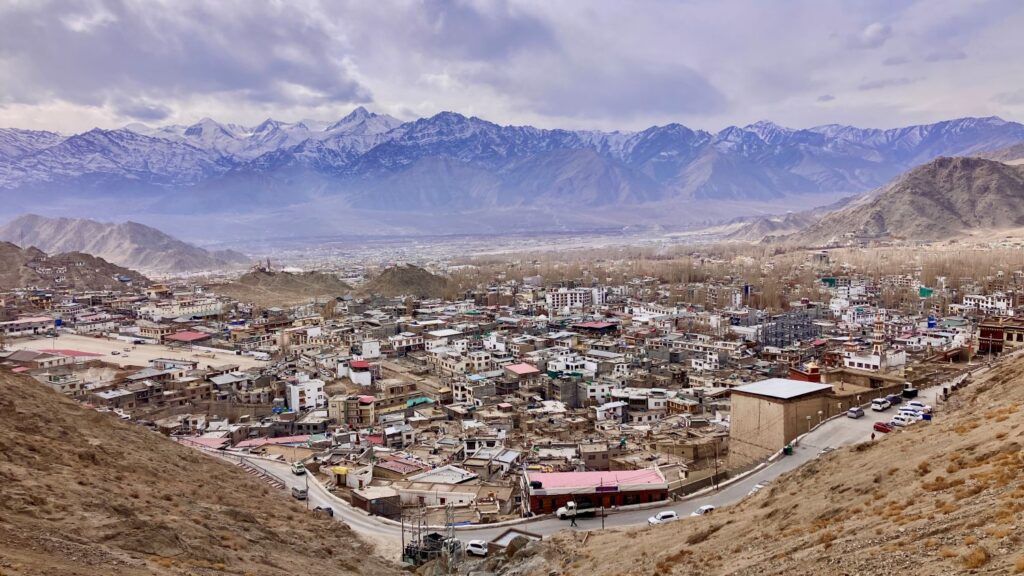
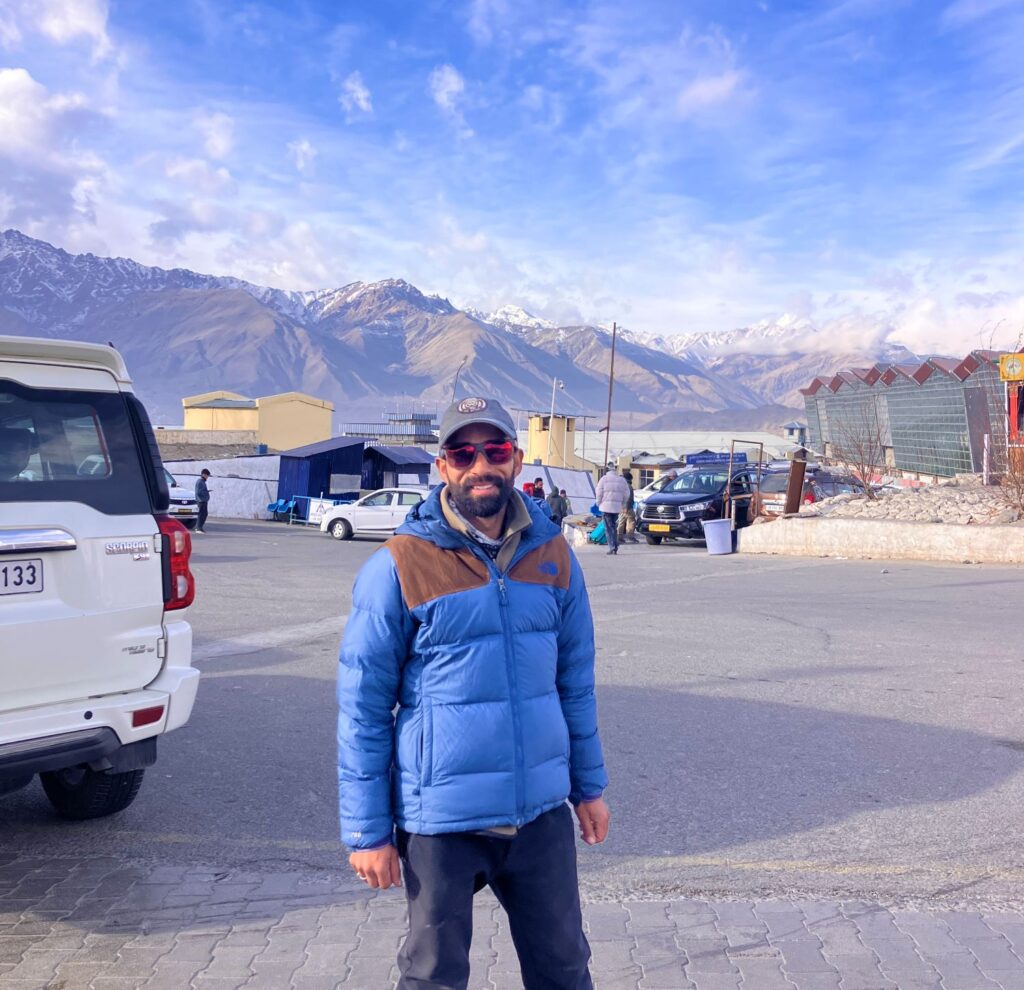
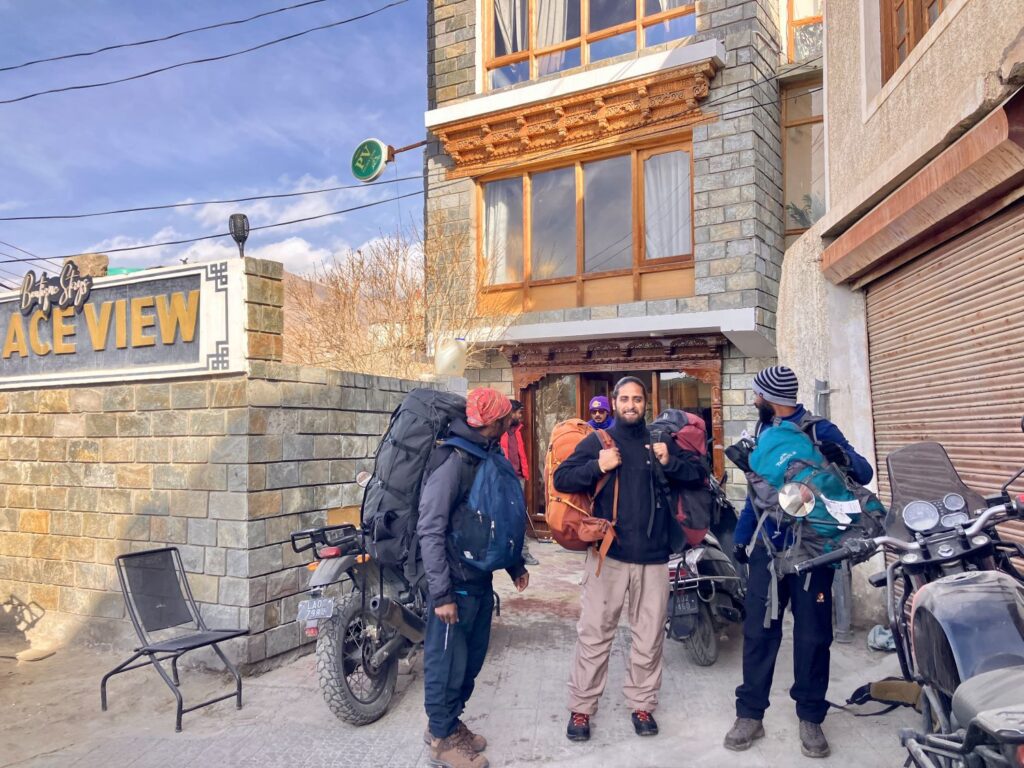
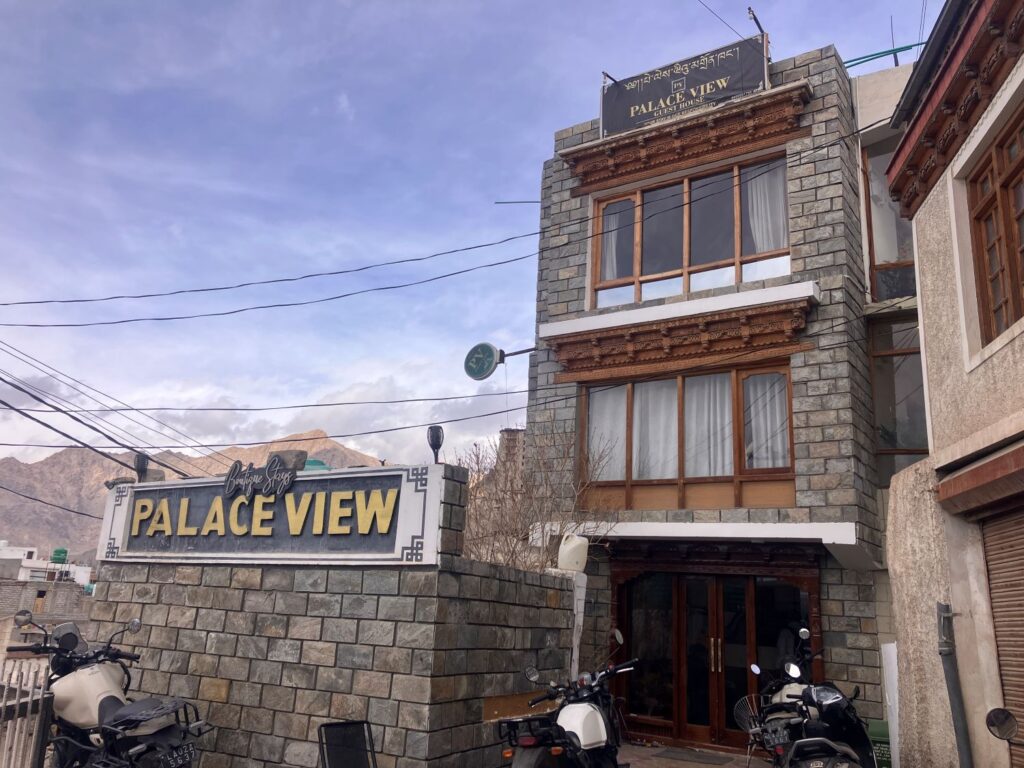
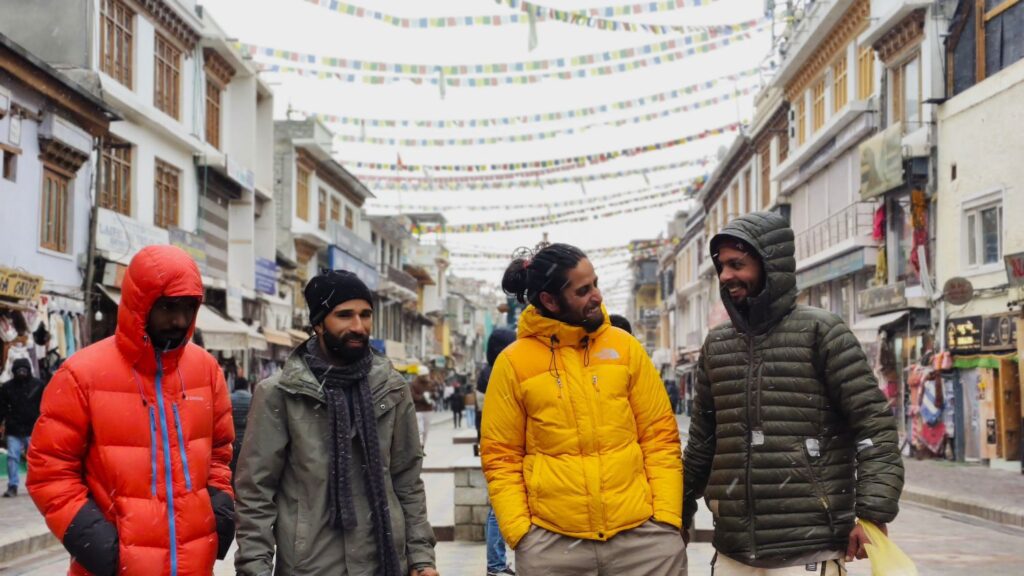
We all reunited at the Leh Airport at 9:00 AM, where our cab was already waiting for us. We started our journey to Palace View, located near the Mall Road, about 6 km from the airport. After checking in and changing, we visited the local market to buy some clothing and equipment for the journey ahead. We had lunch on Mall Road, where another climber, Akhil, joined the group. With Akhil’s arrival, our team of six climbers was finally complete. We had dinner together, discussed our upcoming plans, and turned in for the night at the hotel.
Day Three: 18th Jan, Leh-Ladakh, Elevation: 4200 m | Temperature: (-5°C to -8°C)
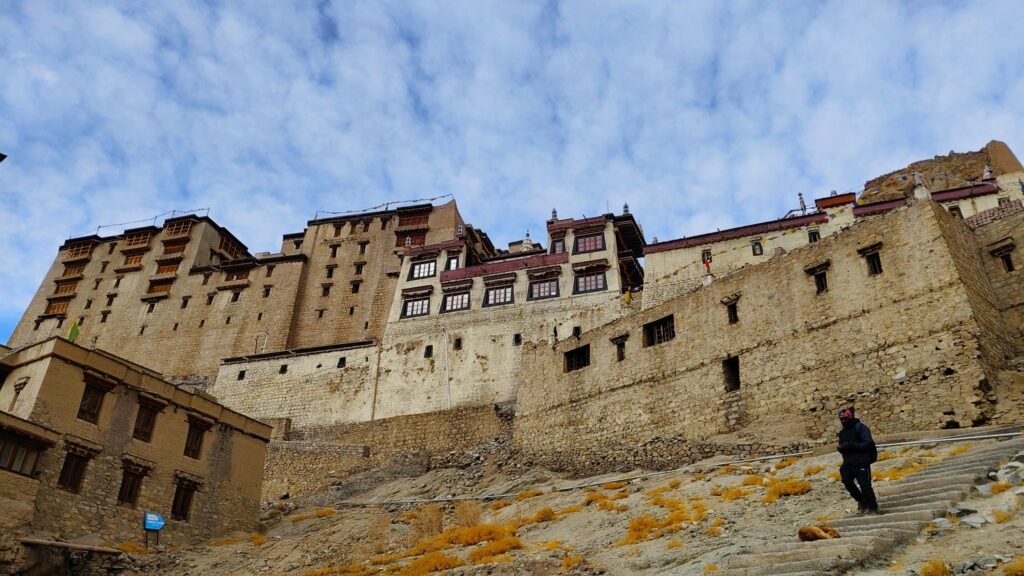
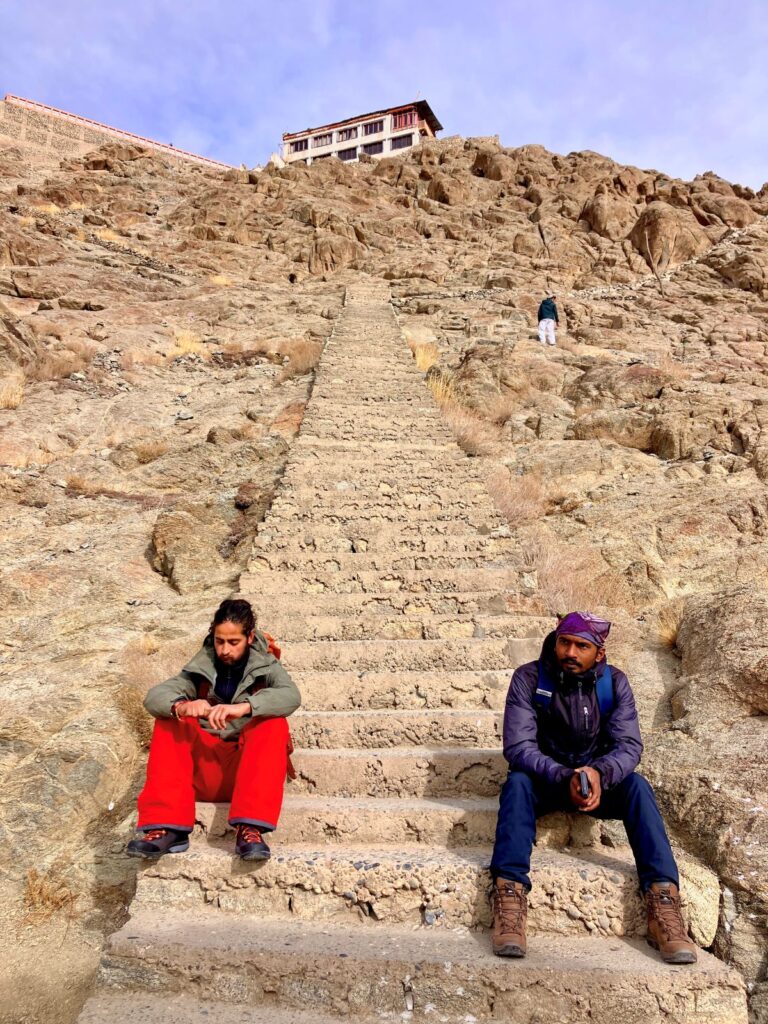
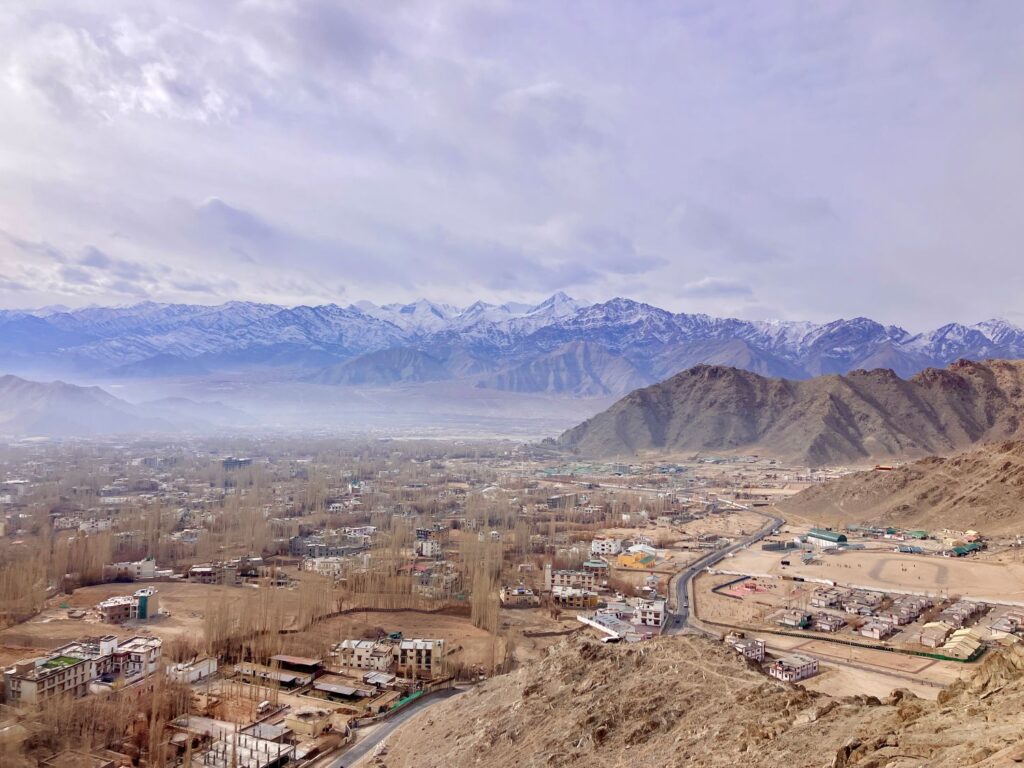
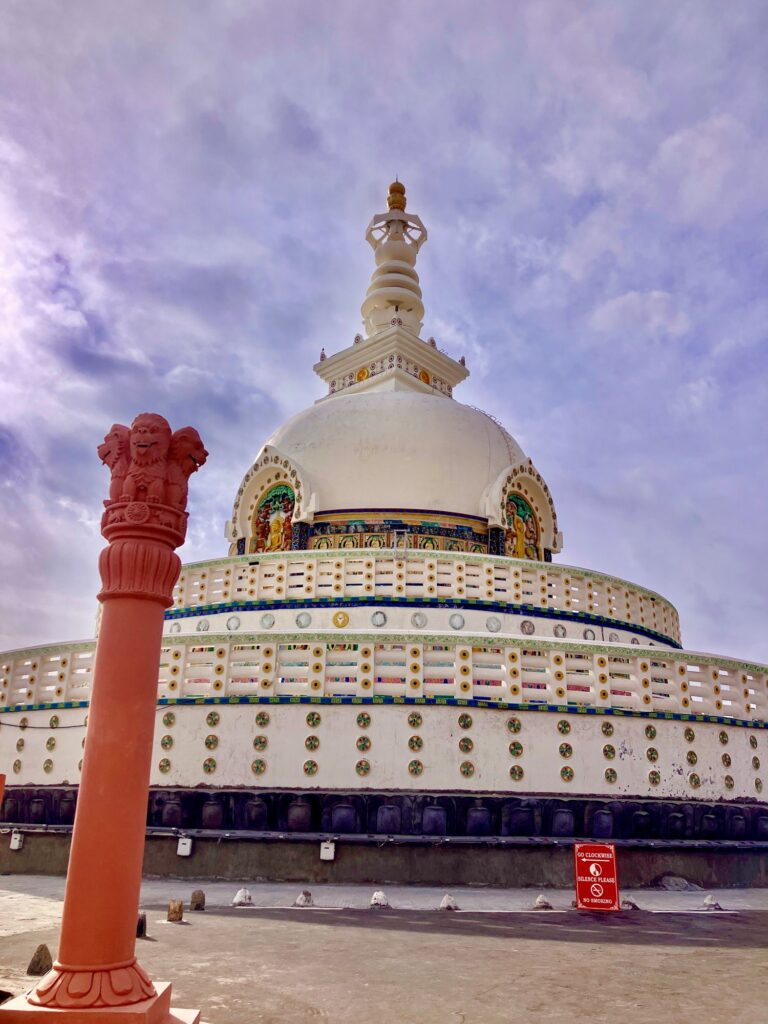
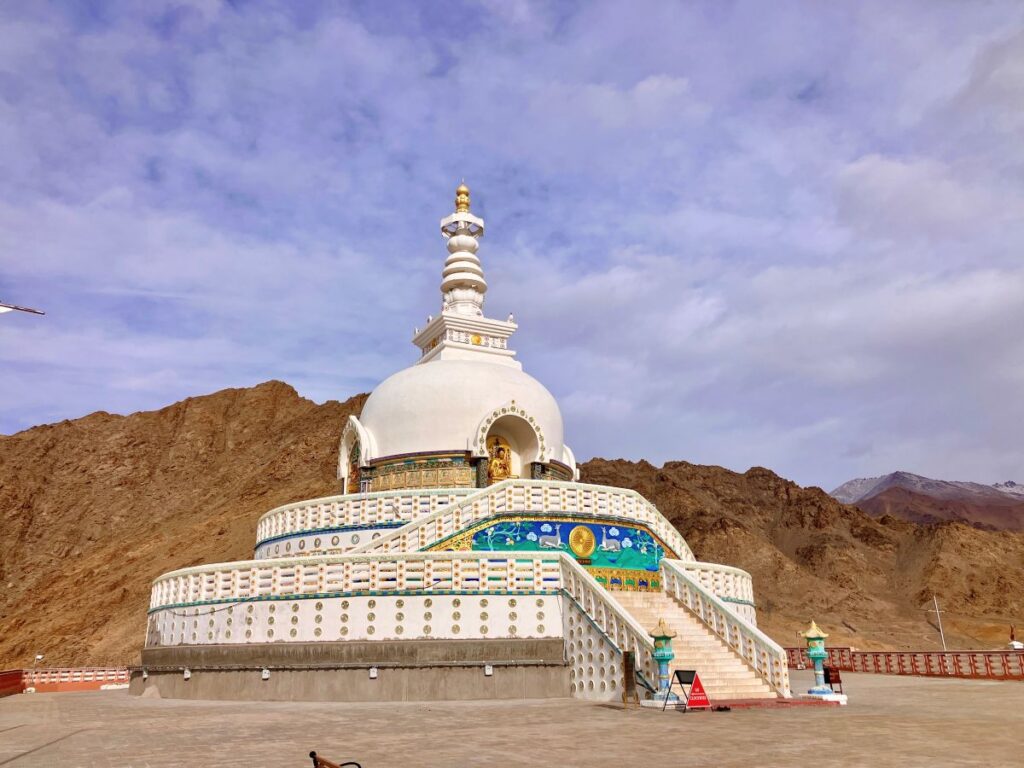
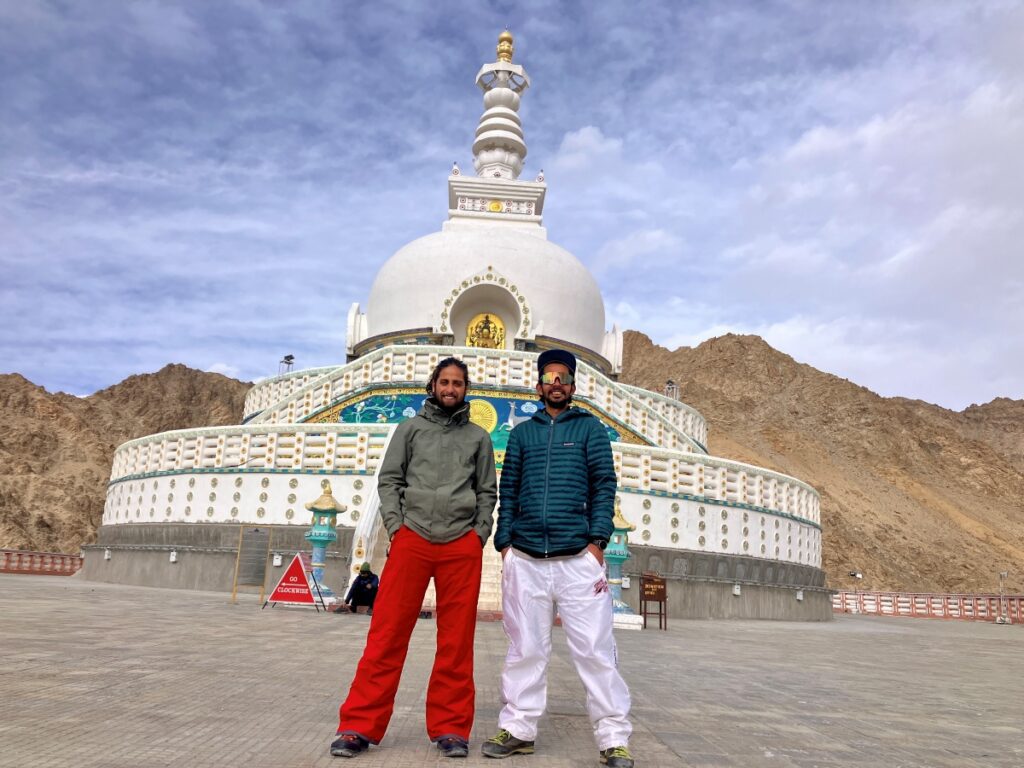
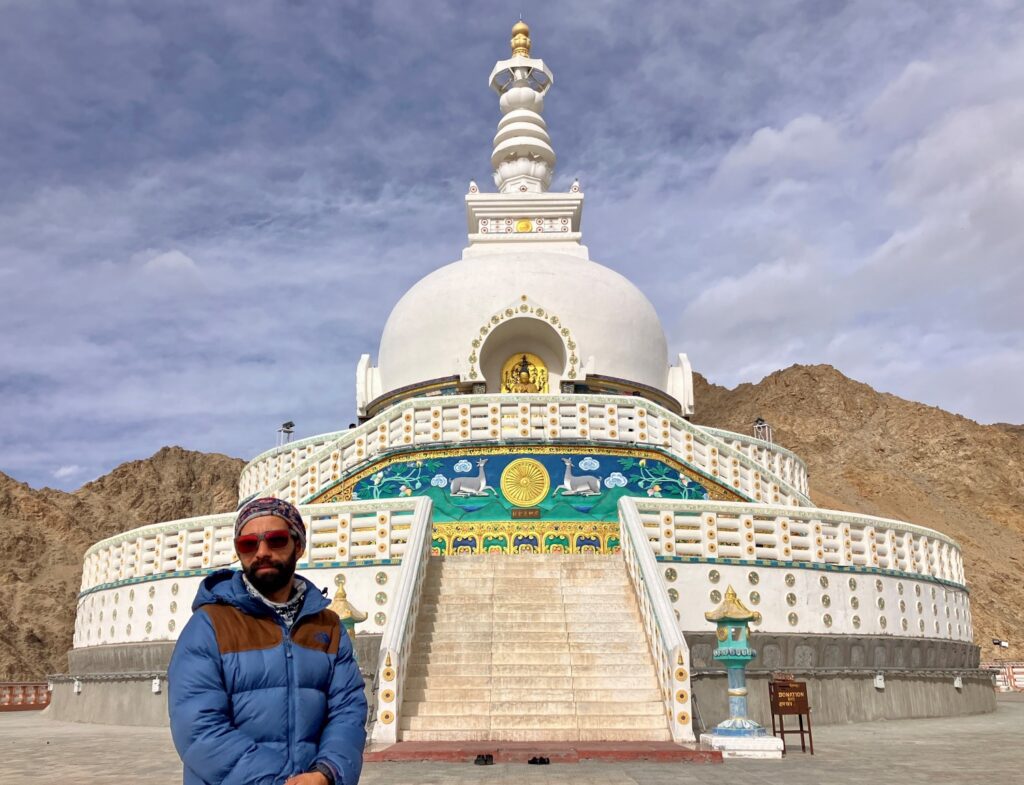
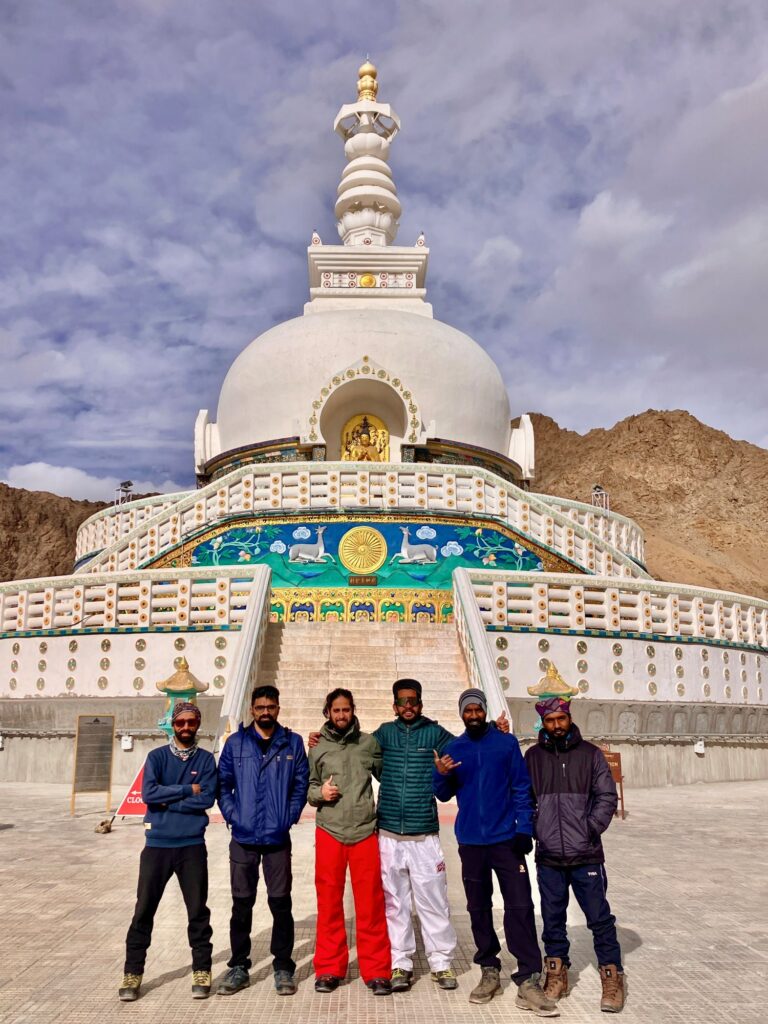
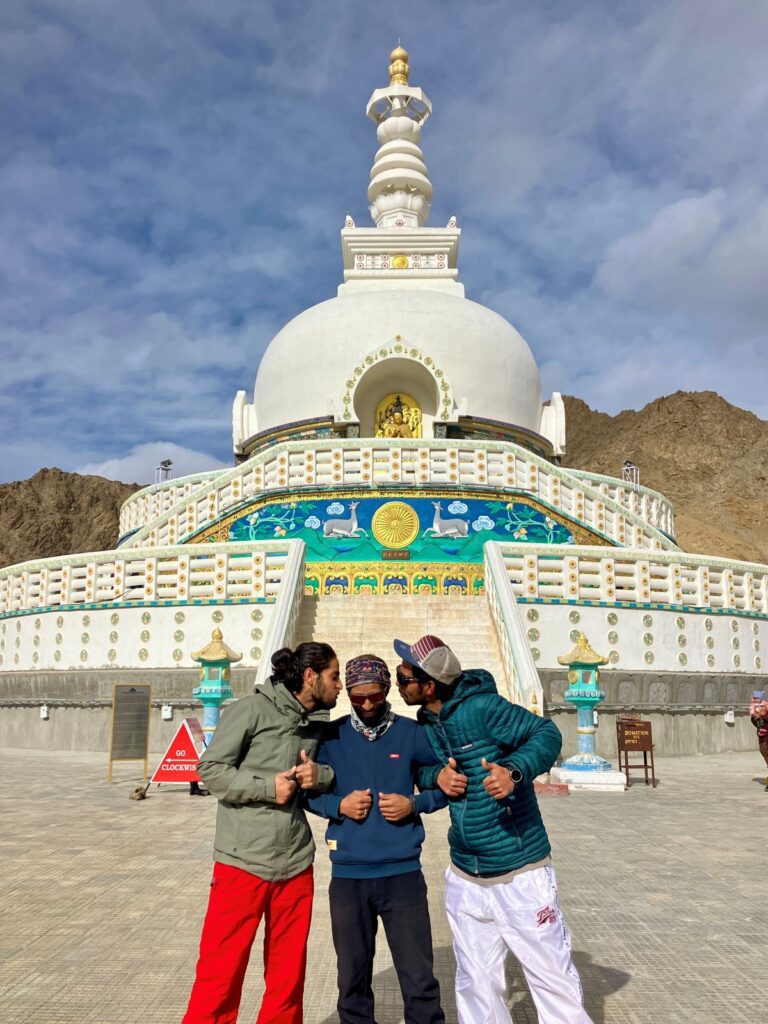
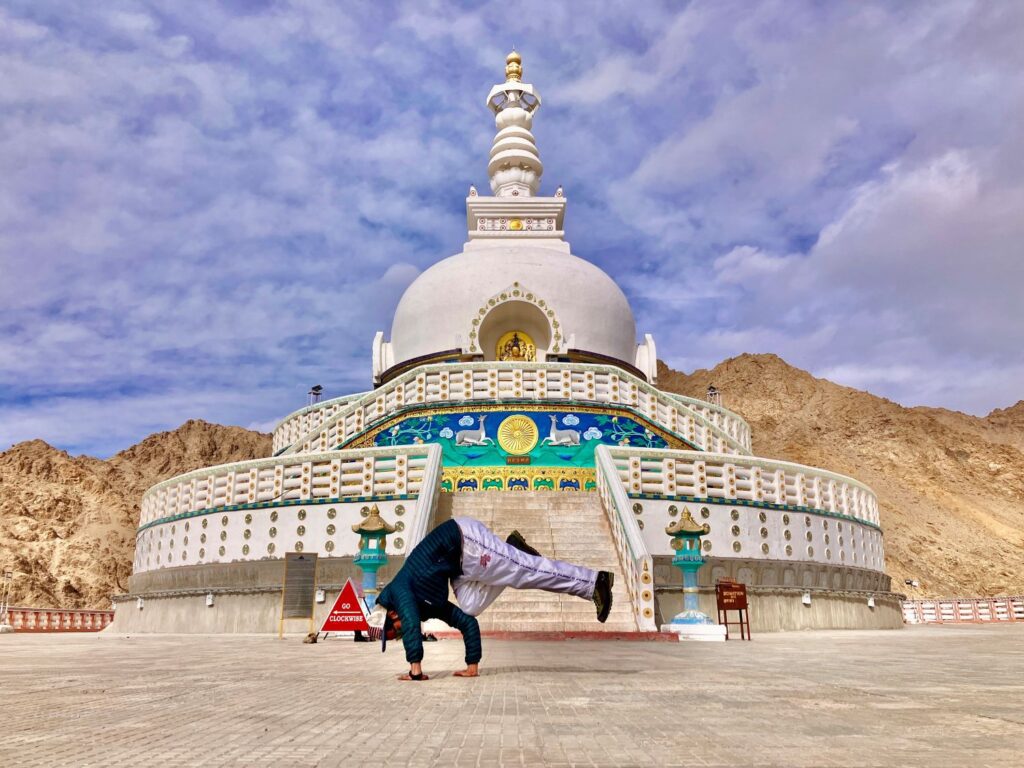
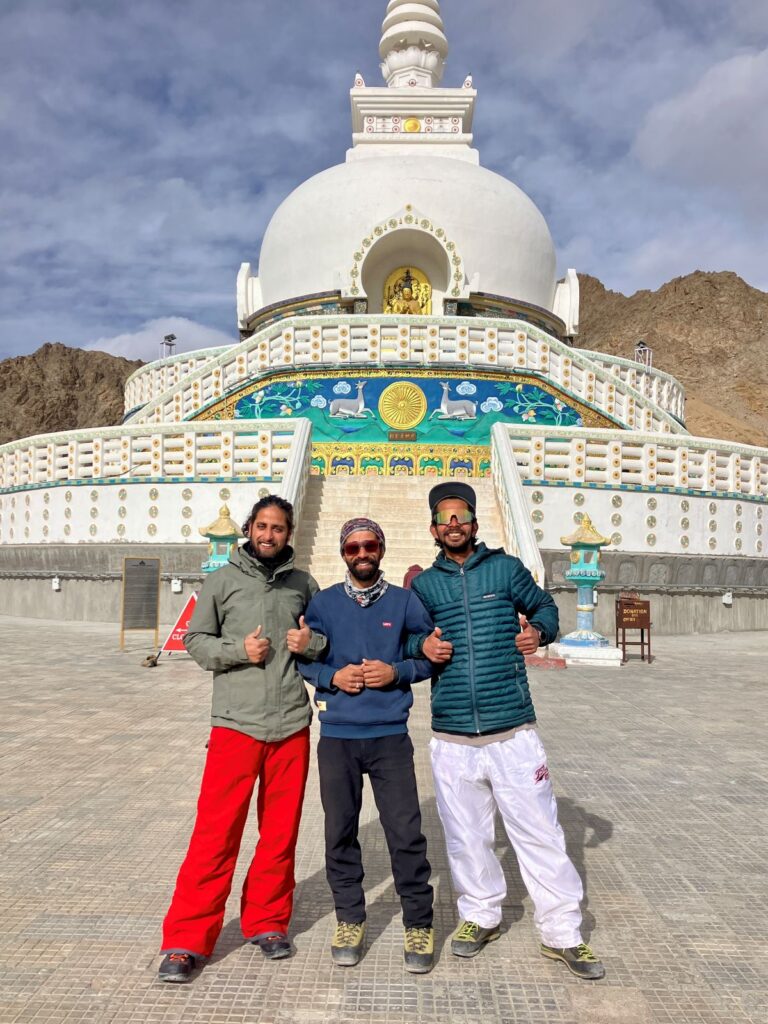
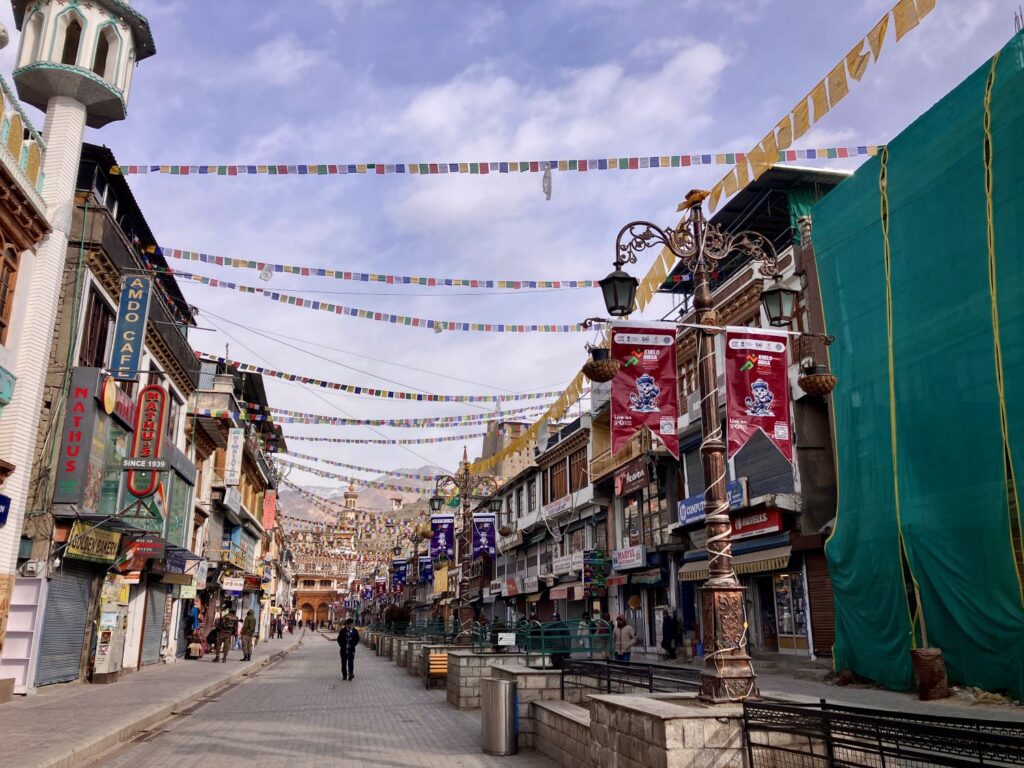
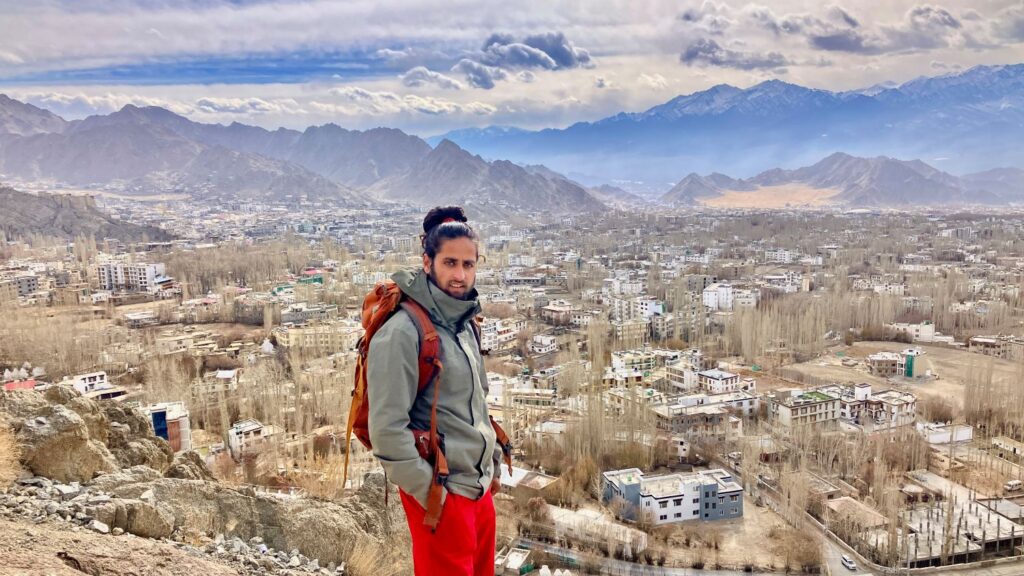
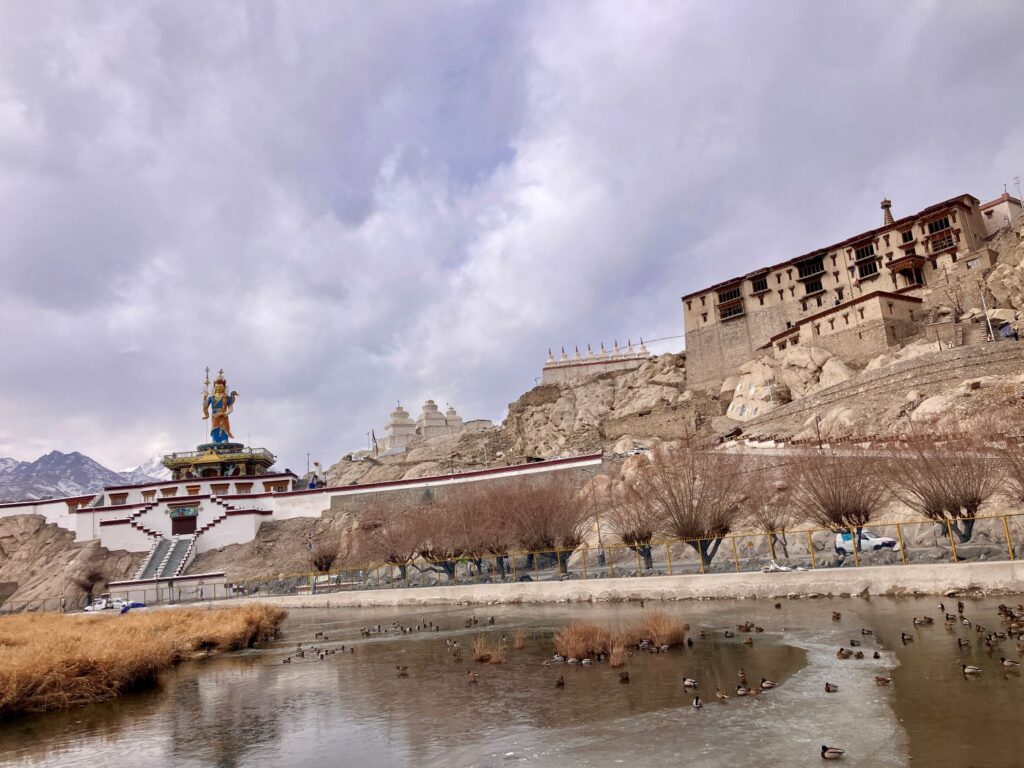
Acclimation around Leh Visiting Beautiful Monasteries of Leh, we woke up around 8 AM in the morning at breakfast and today the plan was to explore and do the acclamation around, we visited Shanti Stupa in the morning and hiked up to Leh Palace at another monastery near the palace, came back to Leh market around 2:30PM for lunch. We all had lunch together and then checked all the gear and bought all remaining gears and rental equipment.
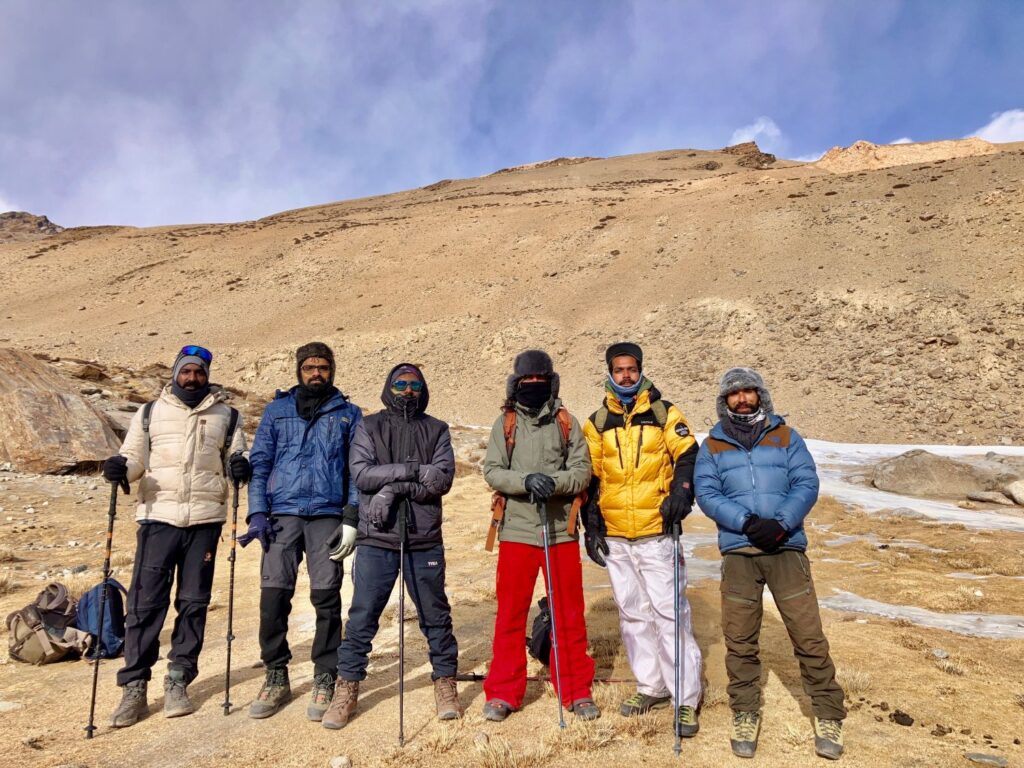
Expedition Leader – Rajesh Giri | Depute Leader – Virendra Singh
4 Climbers –
- Rishabh Rawat from Uttarakhand
- Deepak Mahanta from Orissa
- Akhil Mythri from Bangalore
- Hari Krishna from Kerala
Local Guide – Mingure from Zanskar, Kitchen Staff – Stanzin Chosphel from Zanskar
Base Camp Manager – Nawang Tsering from Zanskar, moving together with one goal: a safe winter ascent.
Day Four: 19 Jan – Leh-Ladakh to Rumtse, Elevation: 3500m | Temperature: (-10°C to – 15°C)
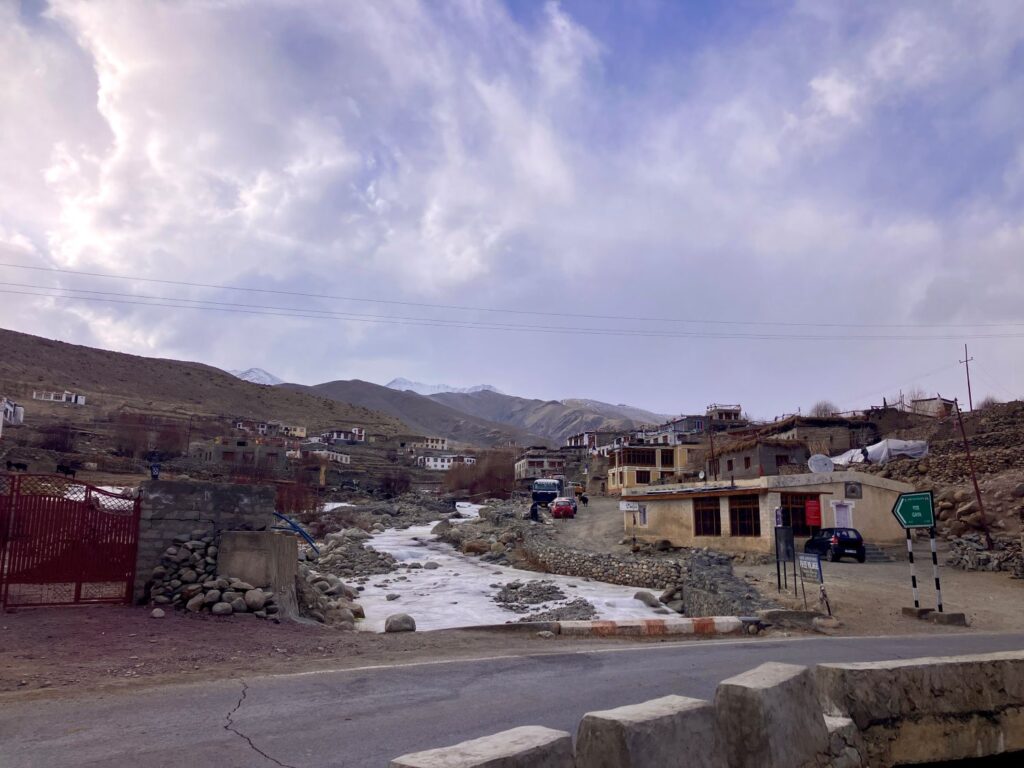
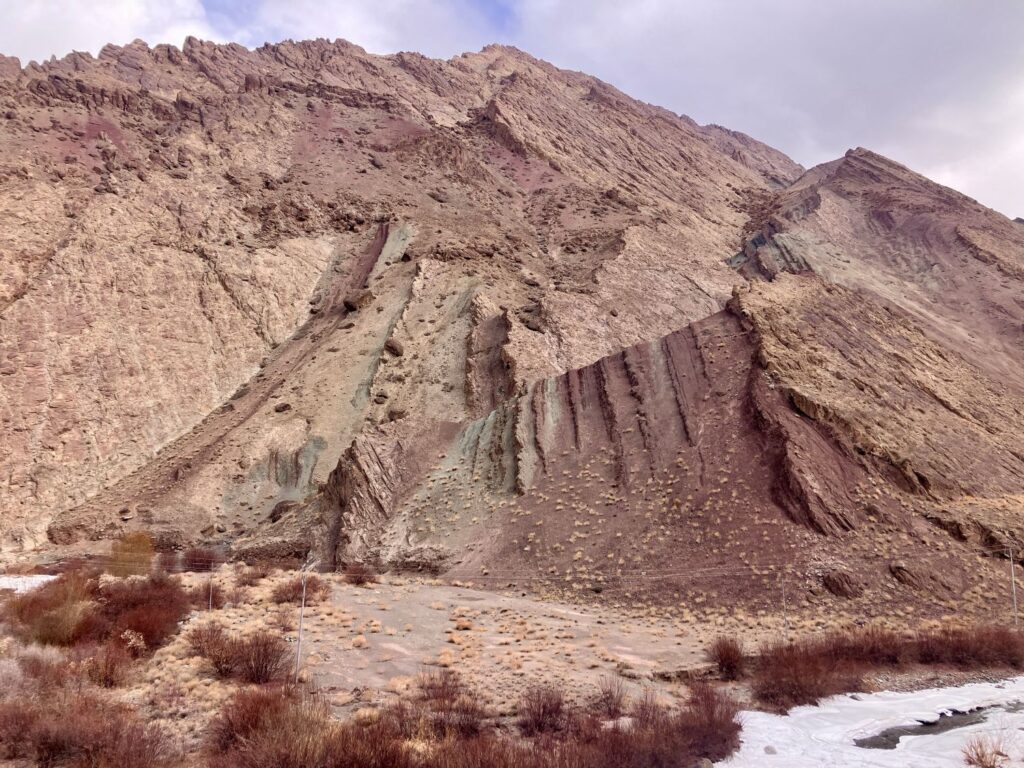
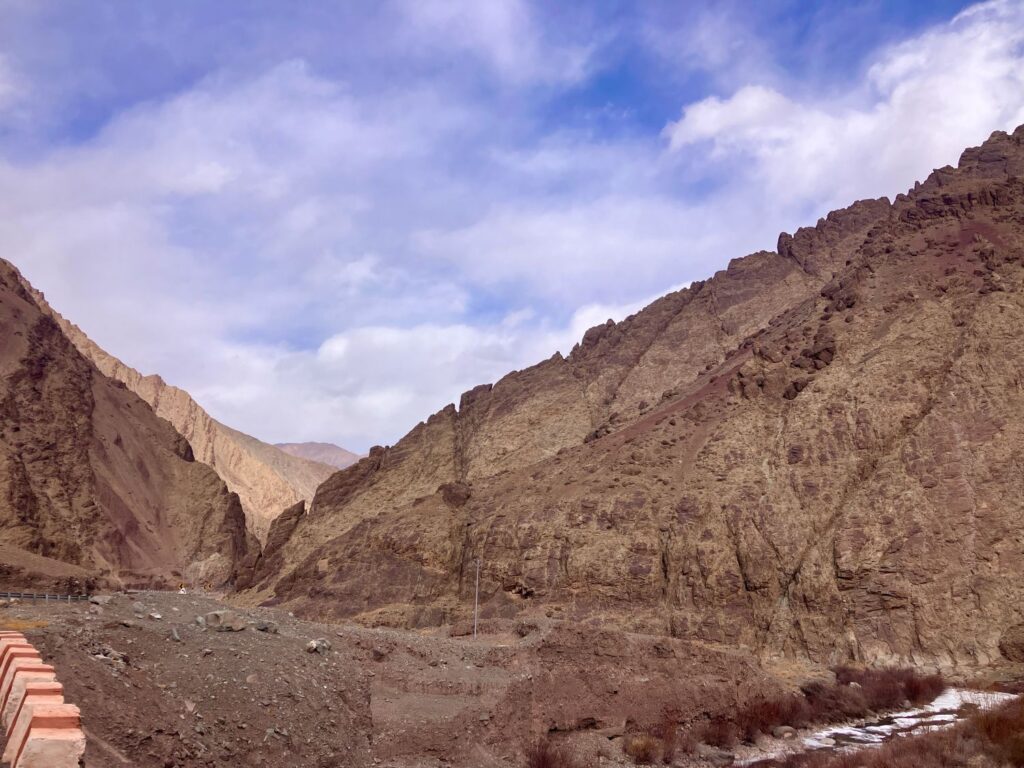
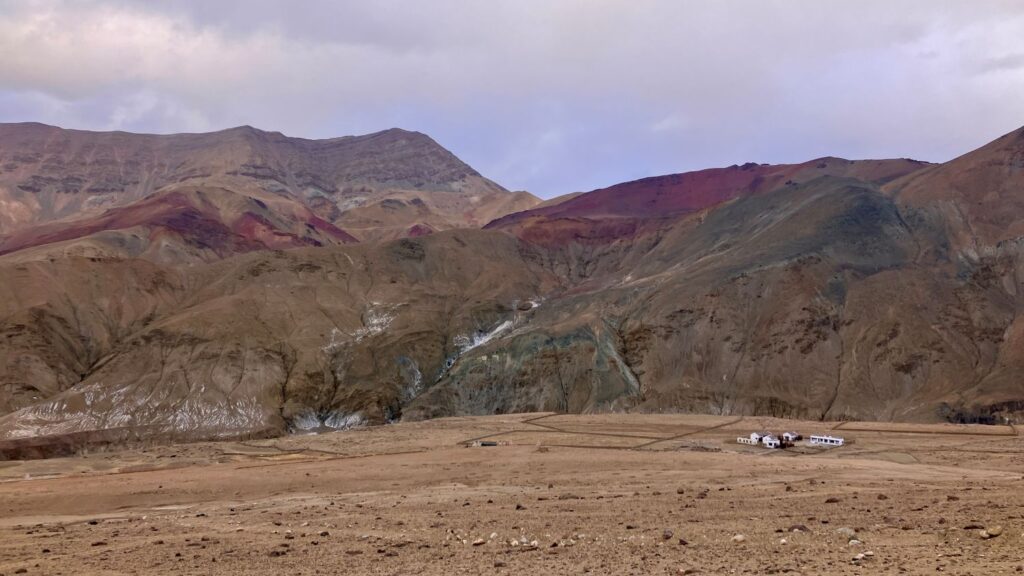
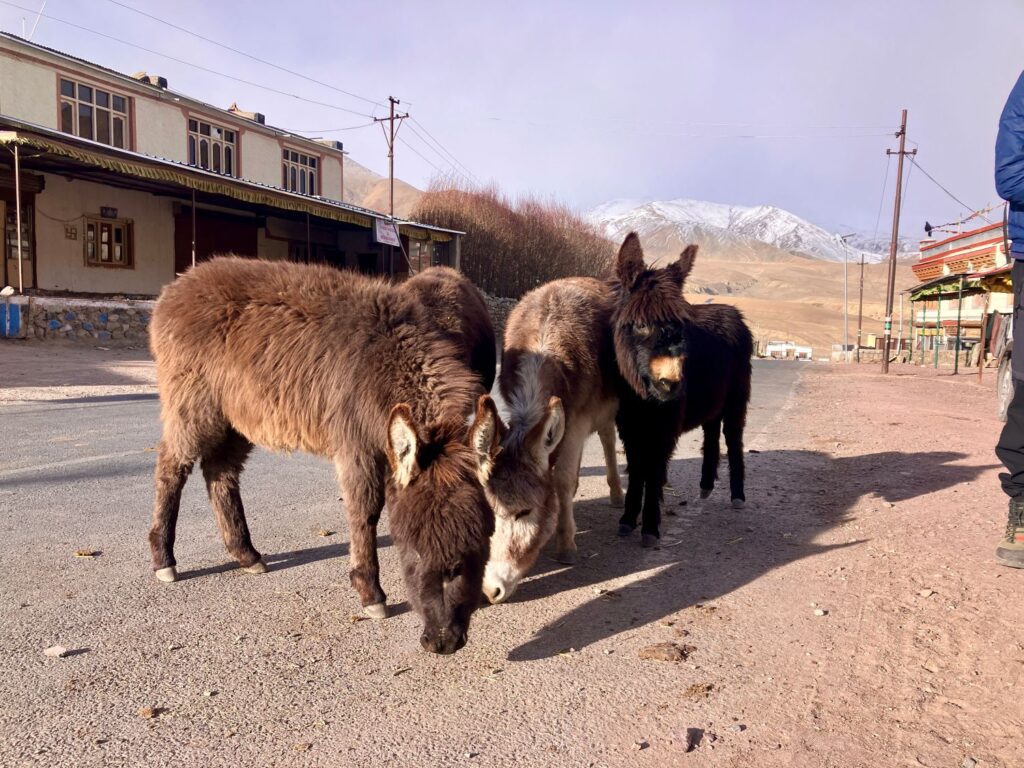
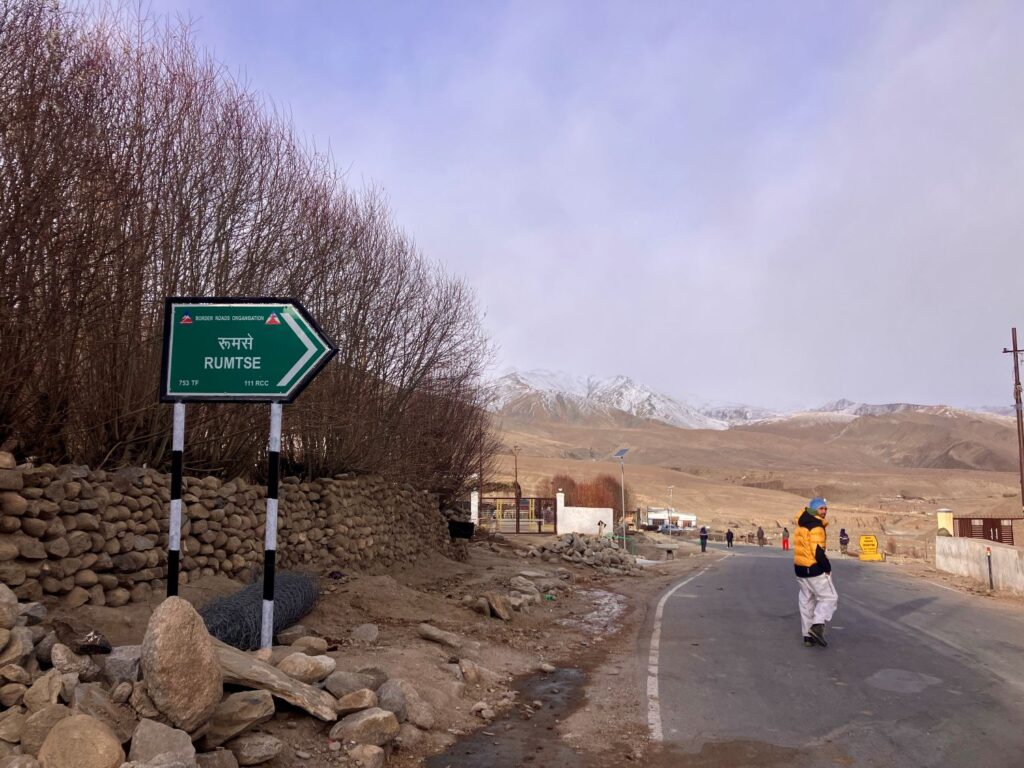
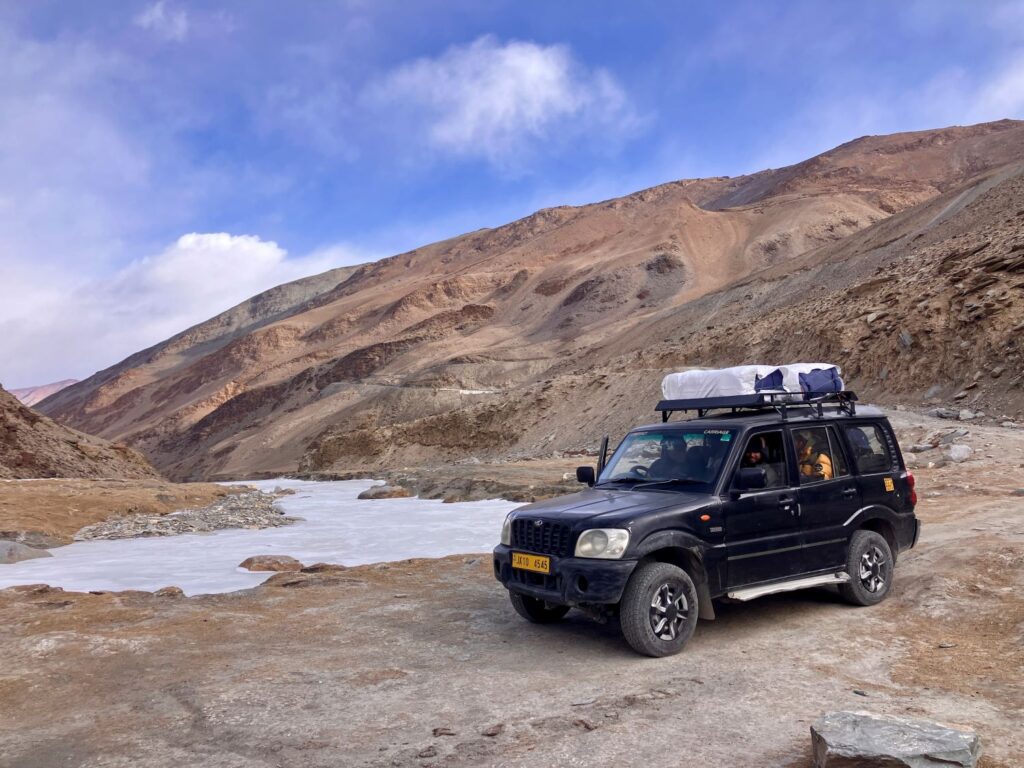
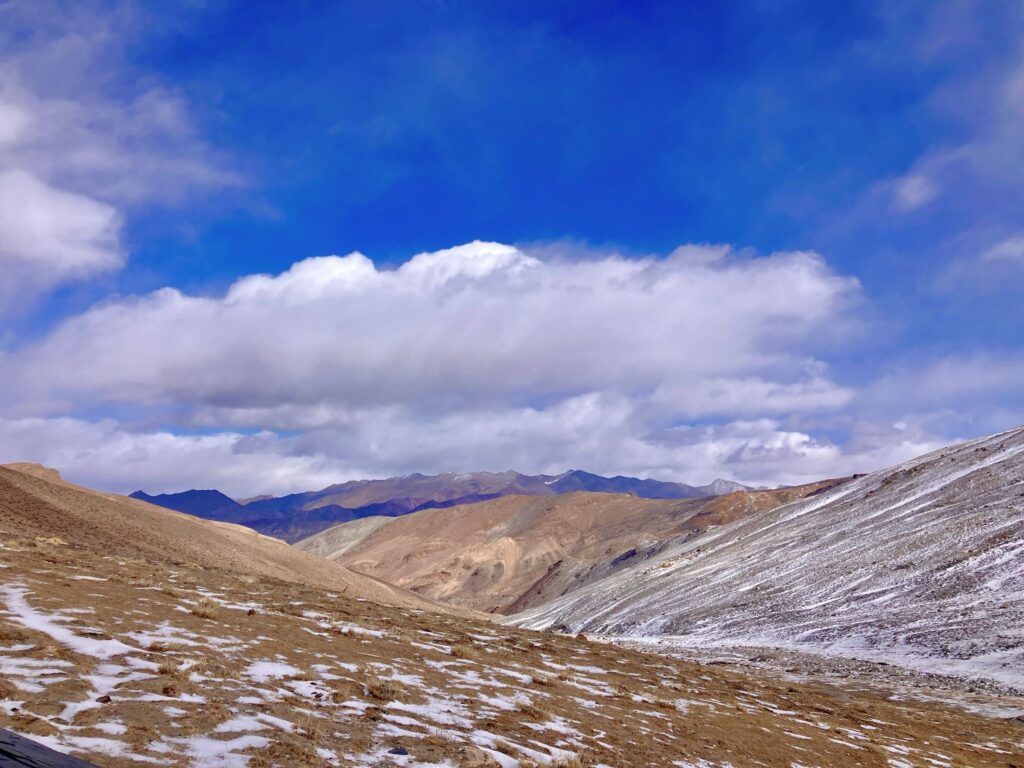
We woke up around 7:30 am, packed our gear, and loaded the backpacks onto two cars. After breakfast, we began our journey to the base village Rumtse. By 11:00 am, we had cleared the first check post by showing our permits and stopped at Upsi for lunch. Driving through the Rumtse Valley, surrounded by vibrant, arid mountains, we finally reached the village around 3:00 pm.
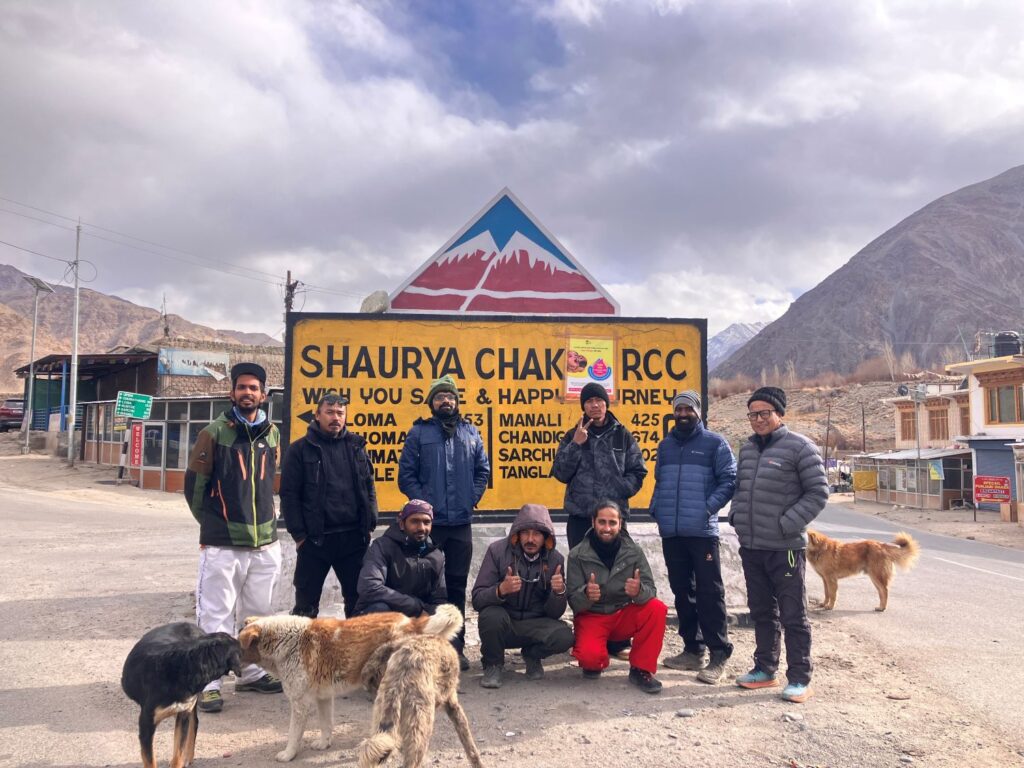
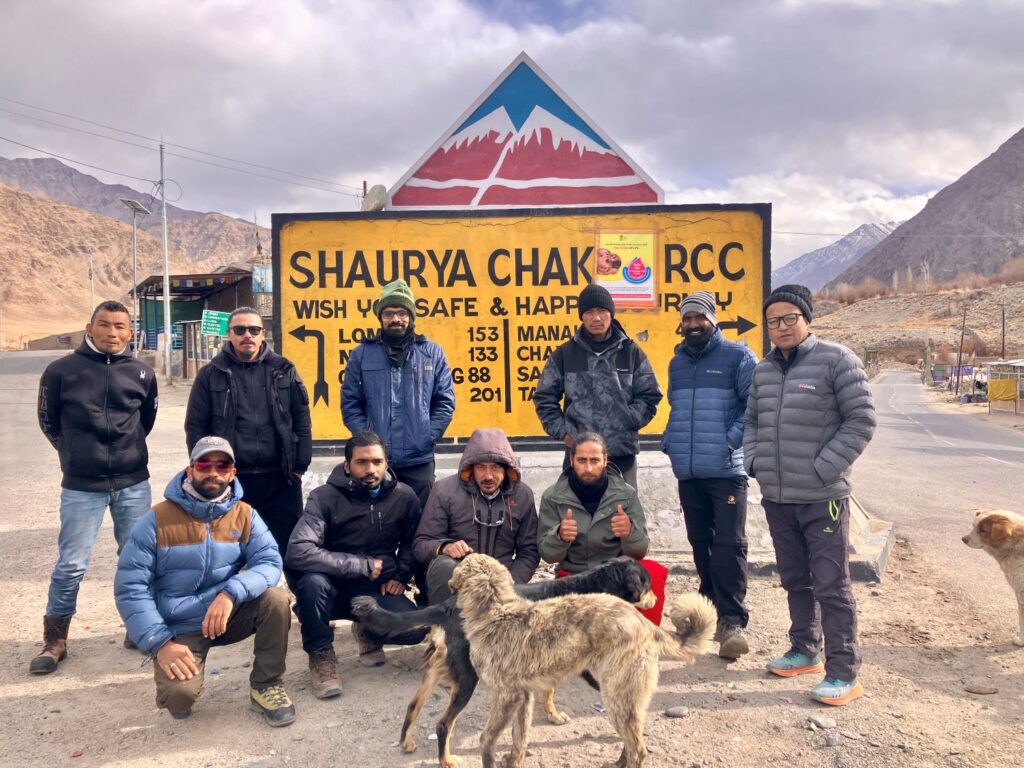
The Leh Police: As we proceeded toward the final road head, a police car approached and flagged us down wondering where we were going in such weather conditions as the highway was closed for Manali. They thought we were going to Manali. In my experience with police officials in India, they are often impolite; they rarely listen to you and prefer to just give an orders. One officer demanded to know where we were going. Our driver, Angchok replied in Ladakhi, explaining that we were heading for the UT Kangri expedition. Immediately, one of the officers began shouting. “Don’t you know the Leh-Manali Highway is closed until June? Why are you heading toward Tanglang-La? Do you realise how dangerous it is?” He continued, “Because of people like you, we have to risk our lives in rescue operations. Just two days ago, we had to rescue three fools from Sarchu!(170km towards Manali)” Angchok politely tried to explain that we weren’t going to Manali, but the officers refused to listen. One threatened us with an ₹80,000 fine and ordered us to turn around, stay in Rumtse for the night, and return to Leh the next day. With no other choice, we turned the cars around.
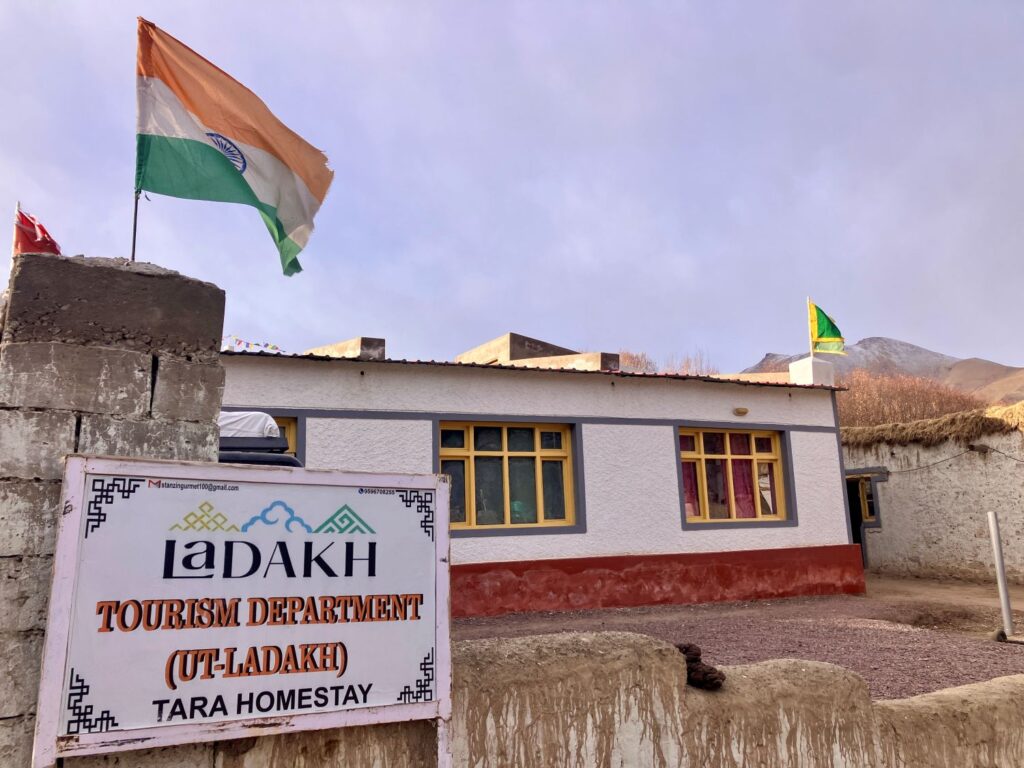
They followed us until we stopped near Rumtse. We tried one last time: “Sir, we know the highway is closed. We aren’t going to Manali. Our starting point is just 6km ahead.” After we presented all our documents and trekking permits, and explained that we were certified mountaineers with full equipment, the senior officer finally relented. However, two local officers remained stubborn, insisting we get an additional special permit from Leh. Adjusting the Plan: Our initial plan was to camp at the mouth of the UT Kangri Valley, but due to these restrictions, we were forced to halt at the village. We checked into Tara Homestay and made the best of the delay by going on a 3km acclimatization walk, gaining 100 meters in elevation. After coming back from the walk we had an amazing chat with our Local support team at Homestay kitchen where they prepared amazing food for us. Rajesh and Mingure Acho drove back to Leh to secure the extra permit. They returned by 10:30 pm. They had dinner and a good night’s sleep, ready to start fresh the next morning
Day Five: 20 Jan Rumtse to UT Kangri ABC: Elevation: 5250m | Temperature: (-18°C to – 35°C)
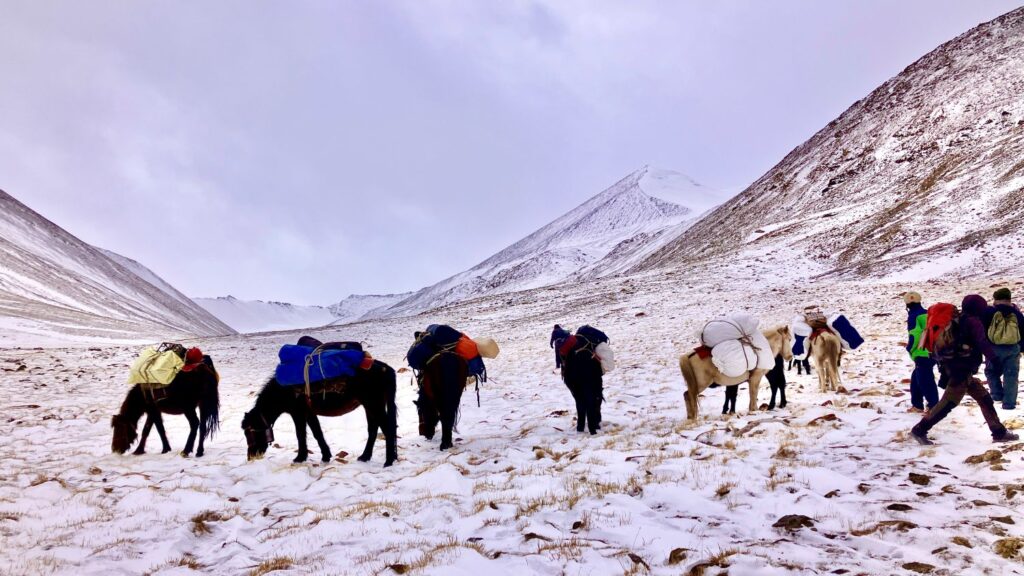
We woke up around 7:00 am, and I went for a morning walk around the village. After I returned and we finished packing our bags and eating breakfast, Nawang Acho tried to start the car. However, because the temperature had dropped to -18 overnight, the engine wouldn’t start as the fuel had frozen. To get it started, we all had to push the car downhill. After pushing it for about 200–300 meters, the engine finally sparked to life. We loaded our equipment and continued toward the starting point, located just 6 km away.
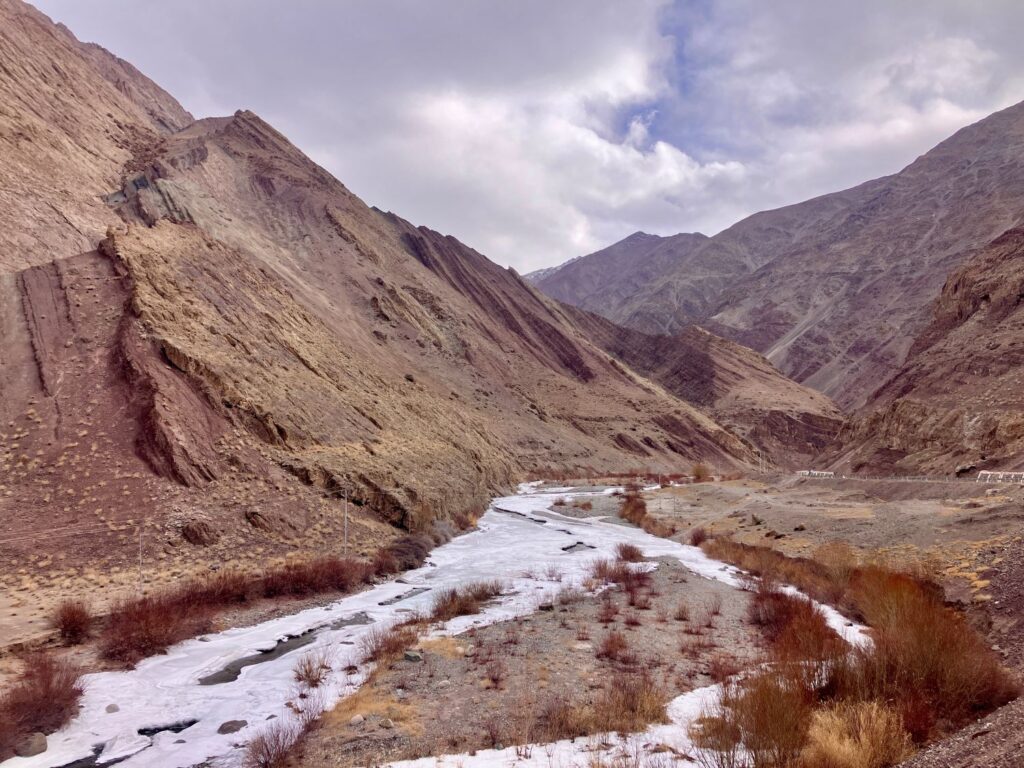
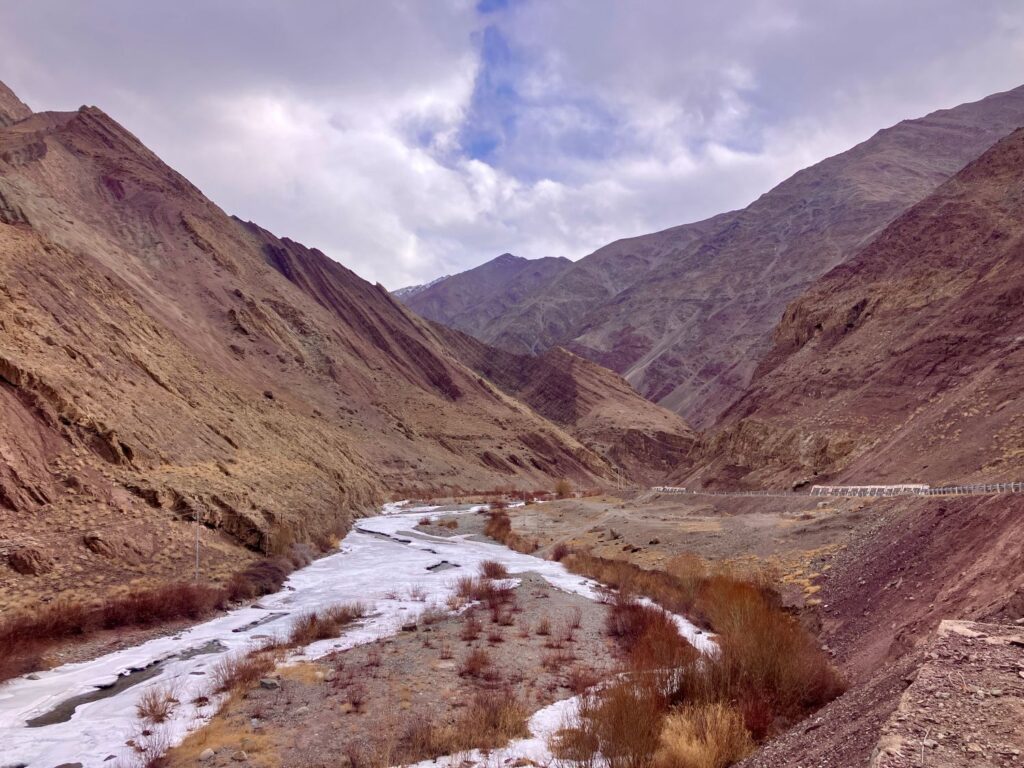
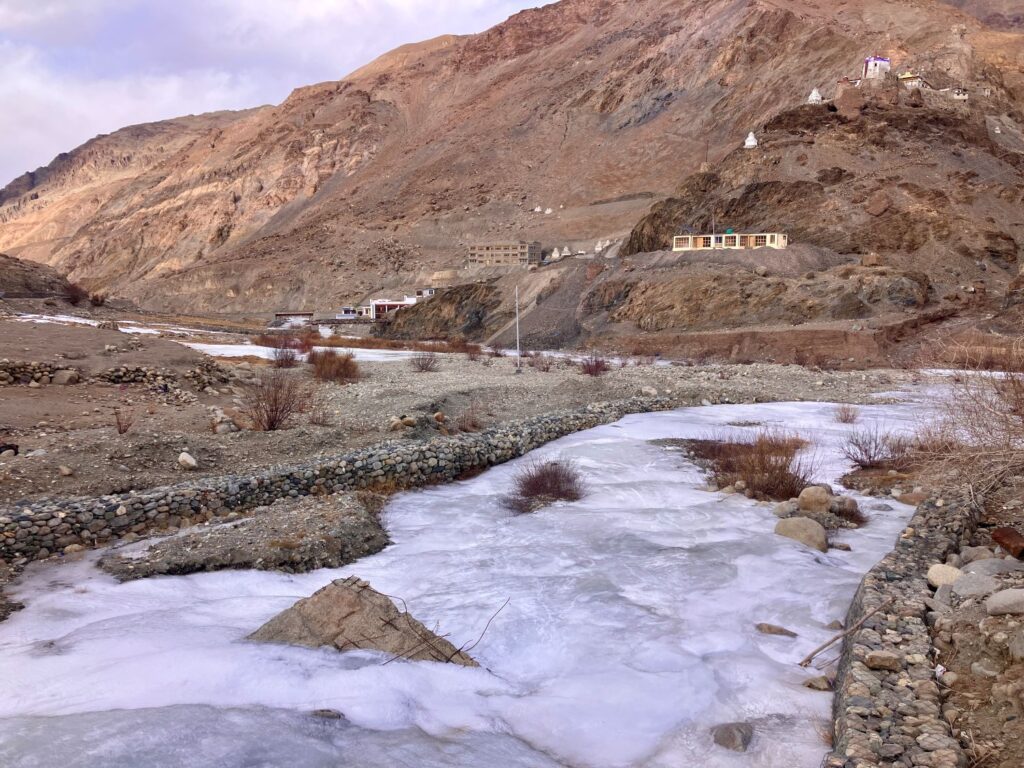
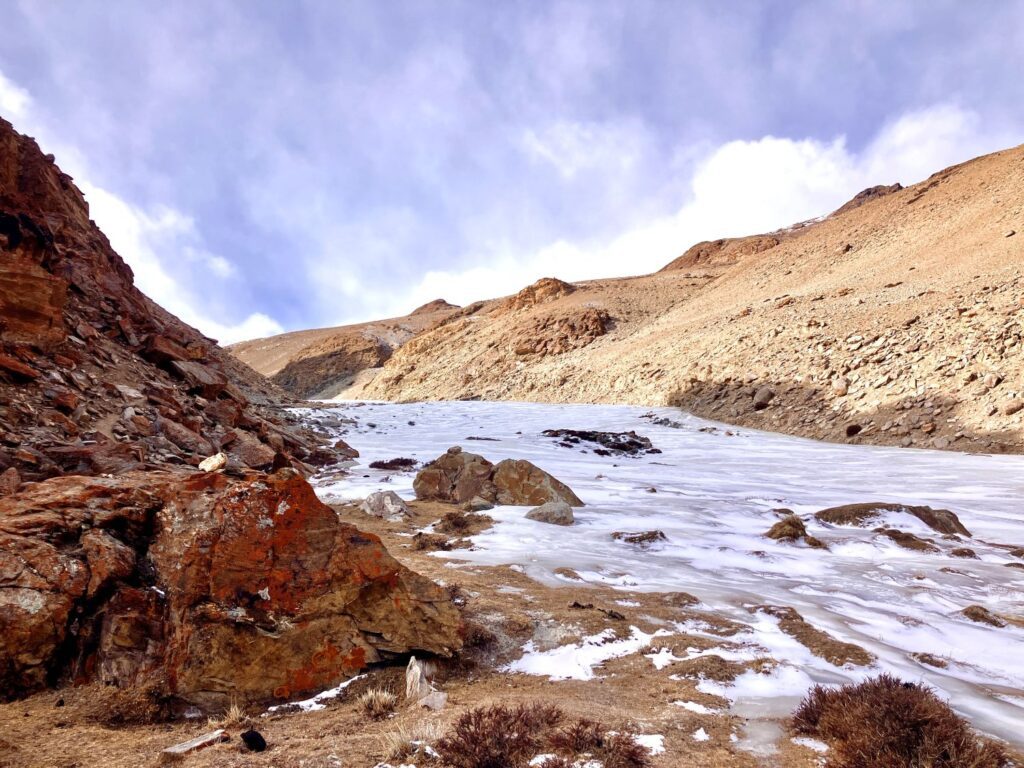
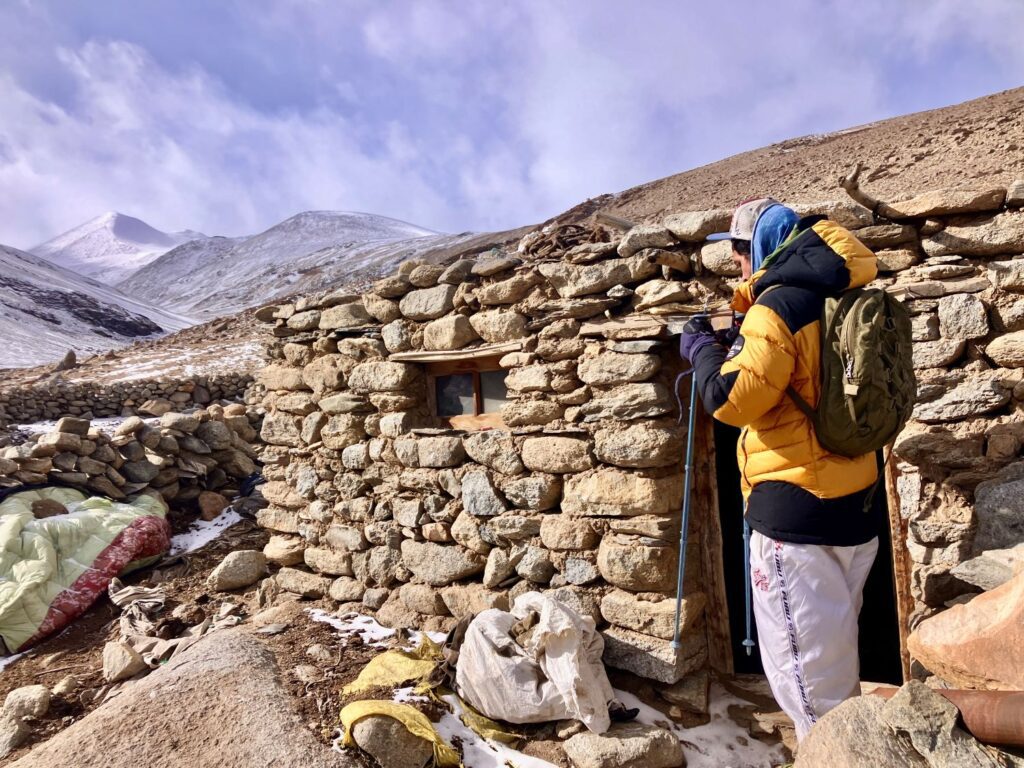
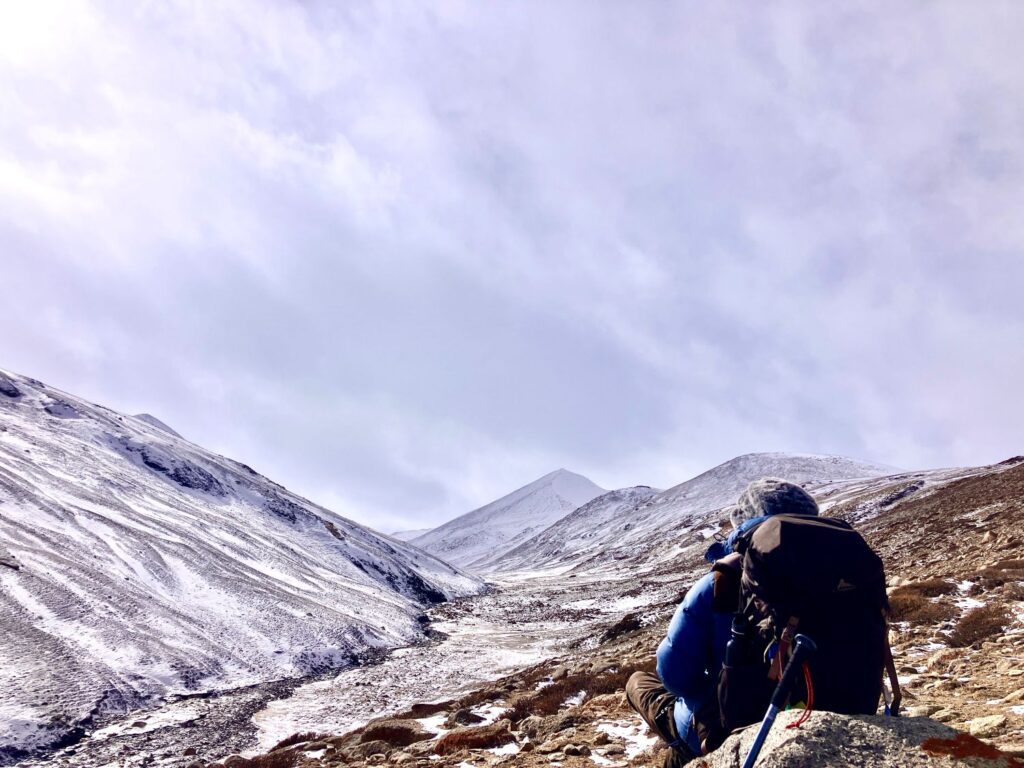
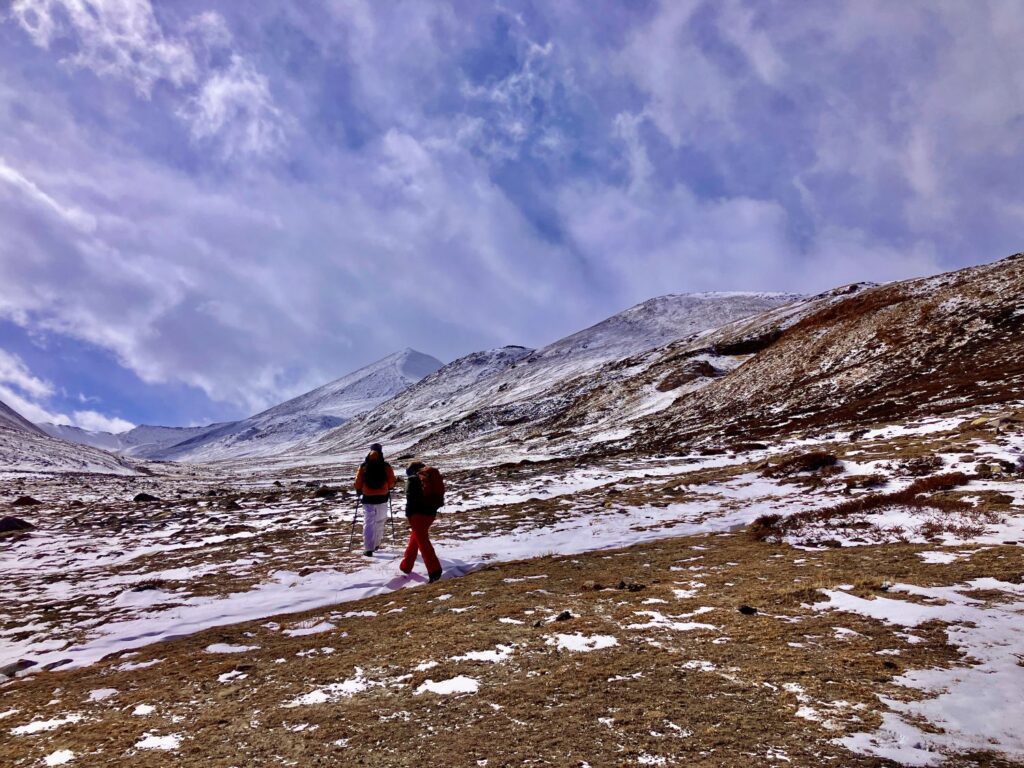
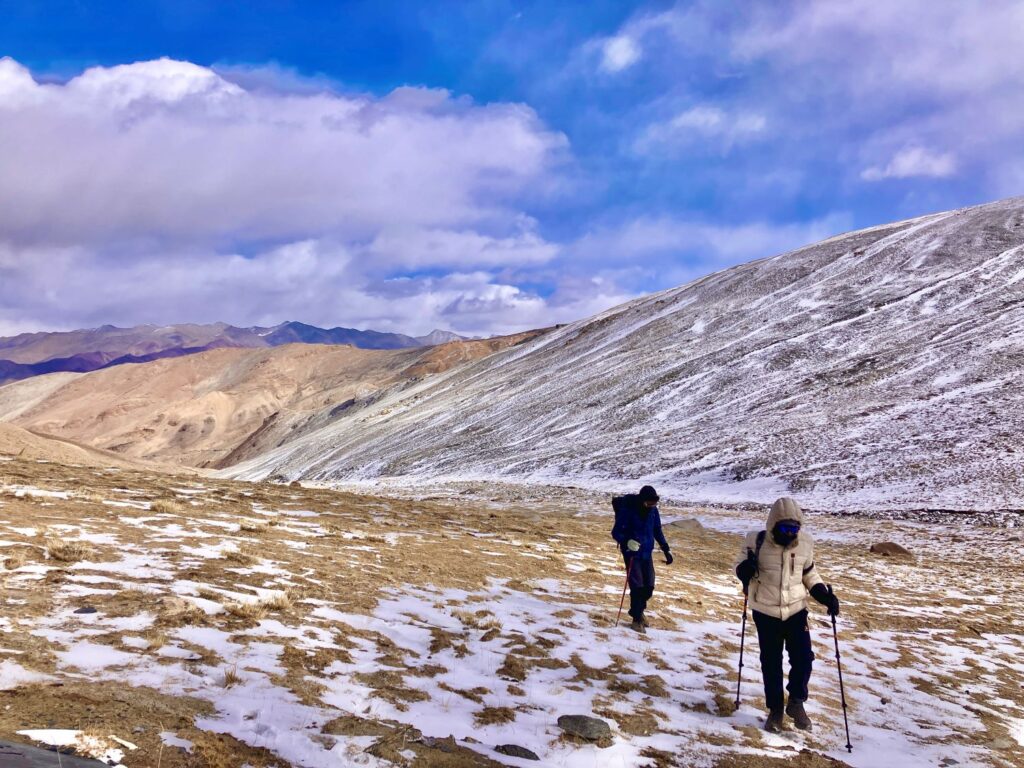
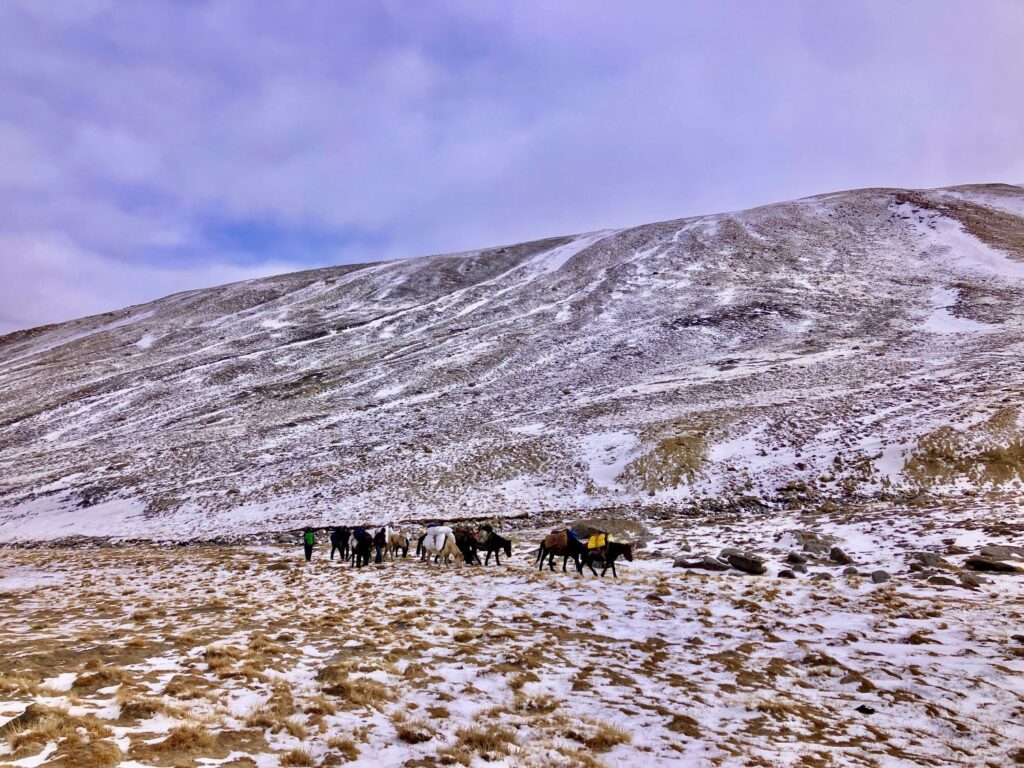
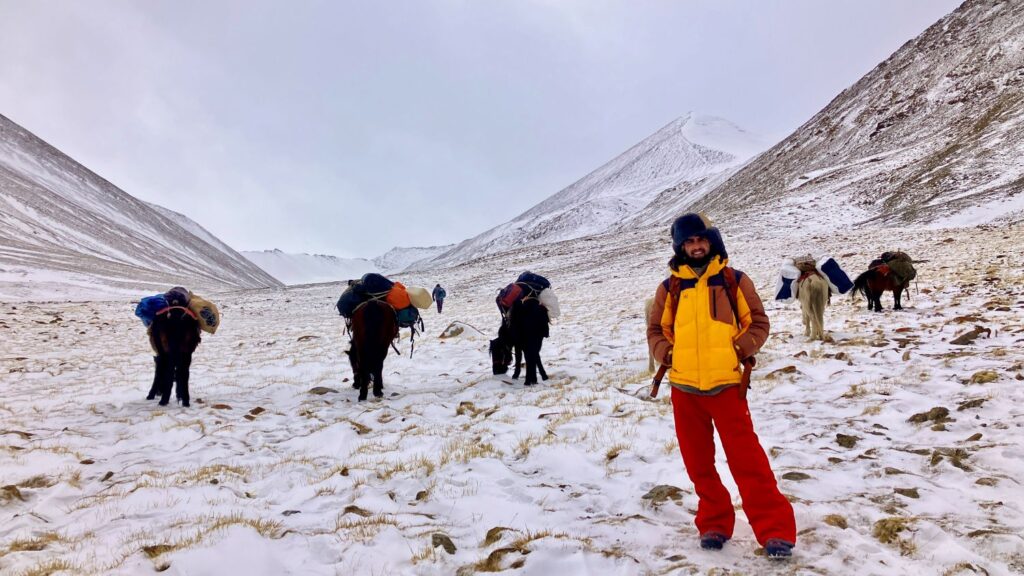
Upon arrival, the landscape was breathtaking. The river was completely frozen, and the atmosphere was quiet, cold, and beautiful. I remembered our summit attempt and trek to base camp back in May 2024; back then, the temperature was around 10 Degree, the river was flowing, and we had to jump over rocks to keep our shoes dry. This time, we were walking carefully on the ice to avoid slipping. After crossing a small frozen stream (nala), we began our trek toward Advanced Base Camp (ABC). We followed the riverbank uphill where we saw snow leopard walking marks on some fresh soft snow that had passed by recently, we eventually crossed the frozen river at a less icy spot about 1 km in. Following the right side uphill, we reached a spot where we found a shepherds’ camp that had been vacated just a week prior. There were two cozy rock huts which would have been a perfect place to camp, but it was too far from ABC, so we decided to move forward.
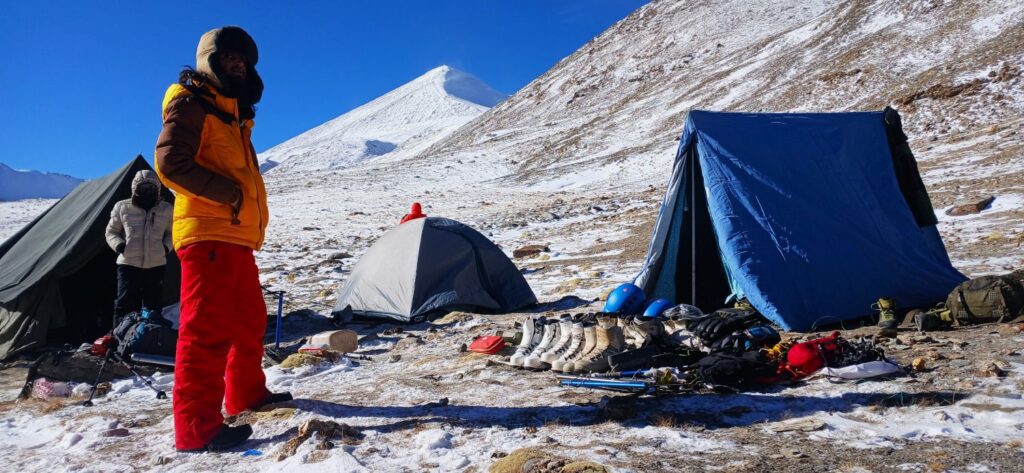
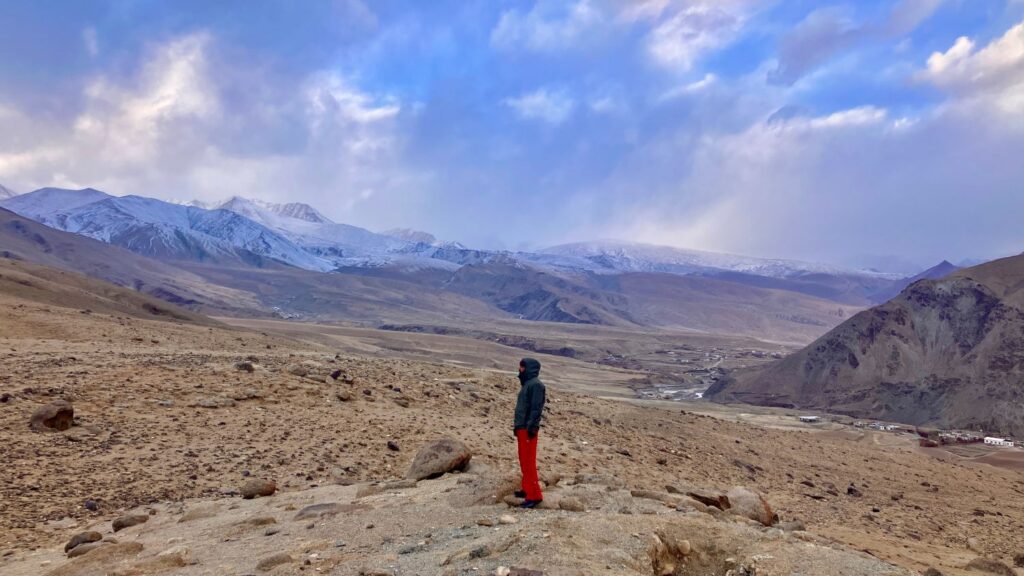
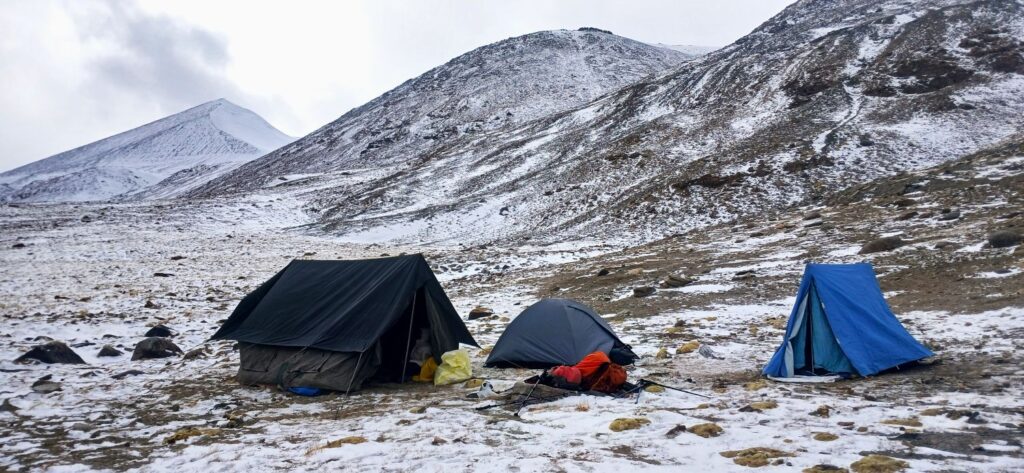
After hiking for two more hours, we finally reached ABC. However, the support team—who were carrying most of the equipment, food, and tents on horses—were far behind. It was incredibly windy and cold in the open area, so we found a rock to shelter under while we waited. An hour later, we saw the team approaching. We quickly unloaded the gear and began setting up camp, while three members started collecting hard ice from the frozen river next to the campsite for water. Once the kitchen tent was set, the cooking team melted the ice and gave us warm water and soup before they started preparing dinner. We settled into our tents, putting on our best winter layers from head to toe. Our home for the next two nights was ready, and we were prepared to survive the cold desert of Ladakh. At an elevation of 5,250 meters, the temperature was -25, dropping to -35 at night, with a constant, biting wind.
After dinner, we nestled inside double-layered sleeping bags, keeping all our layers on to stay warm. Since it was our first night in such conditions, everyone struggled to adjust. After an hour of trying to sleep, a headache began to keep me awake. I was experiencing symptoms of mild Acute Mountain Sickness (AMS). Around midnight, the headache intensified and I felt nauseous; I quickly climbed out of my sleeping bag and went outside to vomit. It was freezing, but I had no choice. Afterward, I felt much better, though a mild headache lingered. Finally, I was able to fall asleep for a few hours
Day Six : 21 Jan – UT Kangri ABC and Route Understanding for night summit Push
Elevation: 5350m | Temperature: (- 18° C to – 35°C)
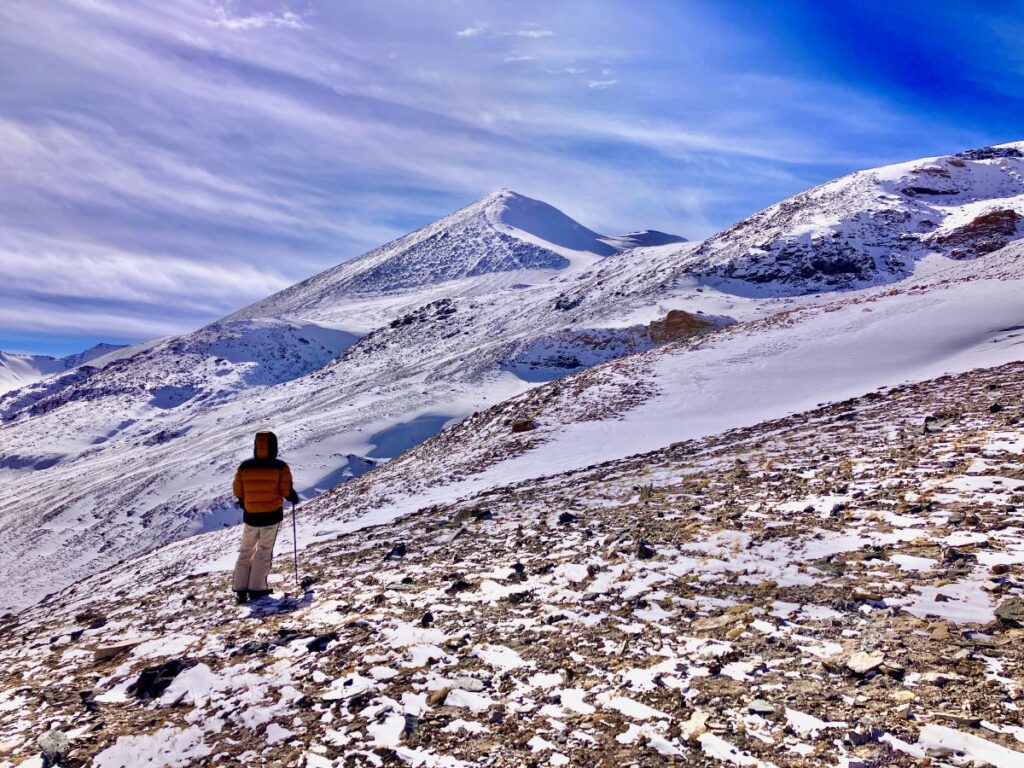
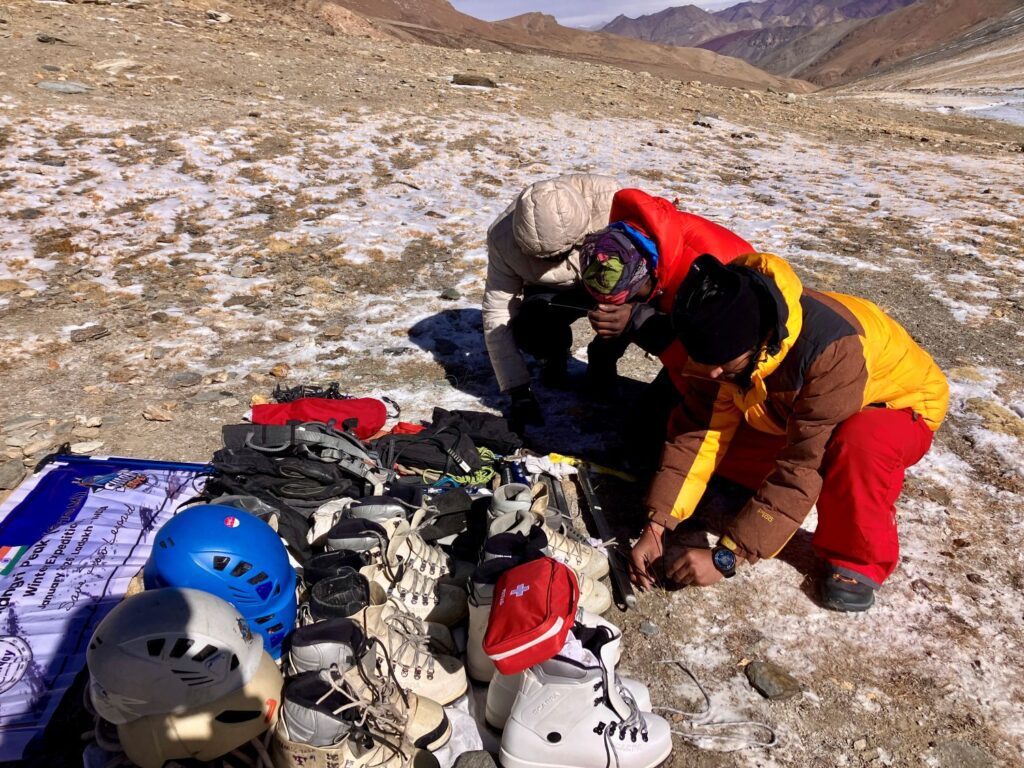
I woke up in the morning didn’t feel like doing anything, I thought I might not be able to make the attempt at night, Rishabh, Rajesh got all the equipment out checked if they all are good to go while Akhil, Deepak and Hari checked their shoes and everything so there is no work is left for night time when team starts the summit push, Hari and Deepak was also feeling low but mentally they were ready for the upcoming adventure, while I was still thinking and trying to get ready, I had some warm water and did a small walk around the camp side and felt a little better I went inside the Kitchen tent and Stanzin offer me for tea and coffee I asked him to give me a strong coffee, and he gave me a cup of coffee I started drinking it slowly slowly and now I was feeling better. we checked all our gears i found that due to temperature drop my crampons rubber lock got broken it was unexpected brand new patzel crampons is not able to bare this temperature, this time we didn’t have any choice se we improvised it with the straps, for the night, after checking everything we put on our snow boots got some warm water start hiking towards summit camp and hiked about 4 km gaining 150 m elevation we reached a point took a rest and returned back to base, after having lunch we packed all stuff for night summit push had chat with team inside the kitchen tent team decided to wake up at 2:00 AM and start the climb at 3:00 AM, after having early dinner we all got inside the sleeping bags as it was too cold to stay out in such temperature all team had good night at 6:00 pm, i had some warm water got in my sleeping bag but couldn’t sleep while rolling inside my sleeping bag the time was already 12:00 and i was not asleep while all other member was snoring..!
Day Seven: 22 Jan – Finally winter Ascent of Mt. UT Kangri 6070 M (19919ft)
Elevation: 6070M | Temperature: – 20°C to – 38°C
The ascent day Rajesh and I had been waiting for for an entire year was finally here. By 1:00 AM, I still hadn’t slept; I was waiting for the alarm to ring because I couldn’t sleep due to the altitude change. I often have this problem when I go to higher camps. An hour later, Rajesh’s phone started ringing the alarm. I told the others to wake up and get out of their sleeping bags, but Rishabh and Rajesh resisted, jokingly telling me to get up first and head out into the cold.
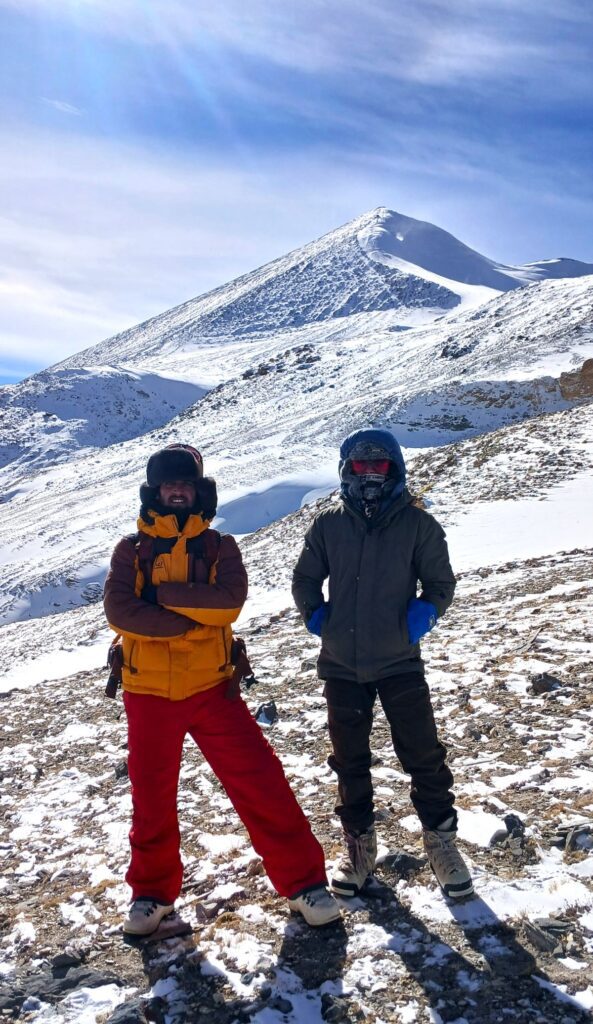
Off-course, stepping out was a difficult decision, as the temperature was hovering around -35°C. However, according to the plan, we had no choice. I quickly layered my wind-stopper over my down jacket, laced up my snow boots, and pulled on my gloves. After covering my head, ears, and mouth, I stepped out into the freeze.
Departure for the Summit
Inside the kitchen tent, Nawang Acho, Stanzin provided us with much-needed warmth water, coffee & noodles soup. Rajesh, Rishabh, and Hari were soon ready, while Deepak and Akhil stayed in their tent to finish layering up. After a quick breakfast of coffee, oats, and noodle soup, we were finally ready for the summit push. It was 3:20 AM. Rajesh took the lead while Tamchos Mingure Acho brought up the rear. It was one of the coldest and most adventurous experiences of our lives. In the pitch-black night with our head-torches on and cold winds biting, we walked in silence. The moisture from our breath froze instantly on our buffs and beards; we felt like the White Walkers from Game of Thrones. We marched on, waiting for the sunlight to raise the temperature and render our headlamps unnecessary.
The Climb
The first 3 km was a gradual climb, making it easy to cover the distance. Rajesh, Rishabh, and I walked in front, while the other members followed about 500 meters behind. We intentionally managed our pace to close the gap and ensure the team moved together. After reaching the base of the first mountain, we began a steep climb along the first nala (gully). Upon reaching the edge, we waited for the team before proceeding toward the next hill. Reaching the Crampon Point required navigating four steep slopes and rocky moraine, which took the team roughly six hours.
The Final Stretch
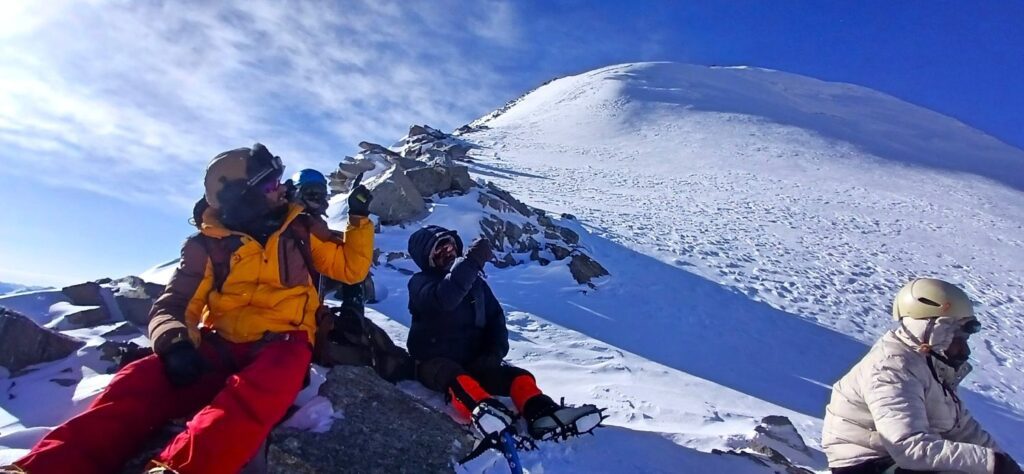
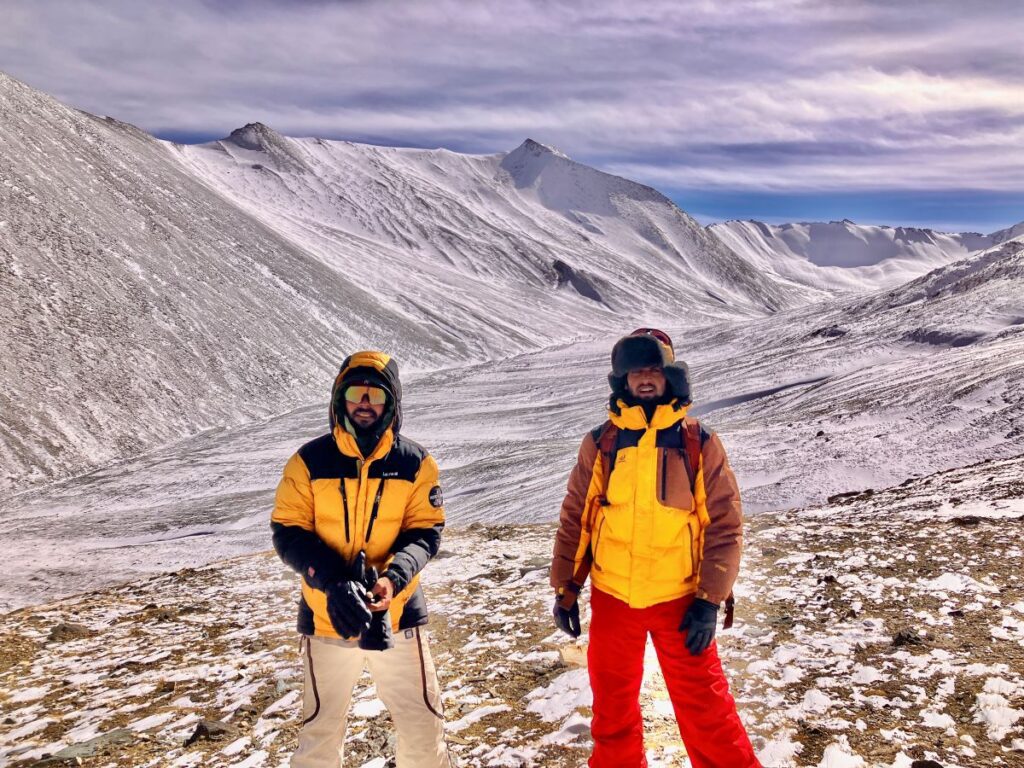
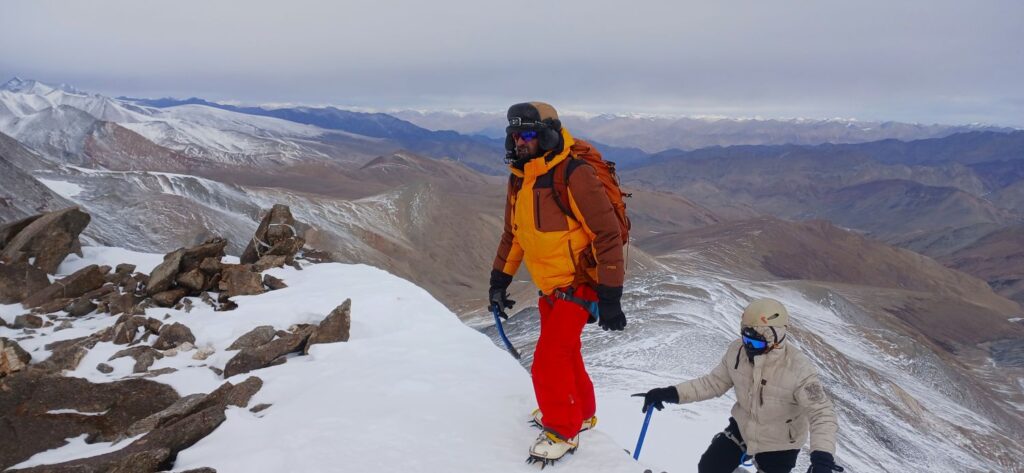
By the time we reached Crampon Point at 5,700m, the sun was rising. The temperature became more bearable as we geared up with our crampons, helmets, and harnesses. We continued through a vast snowfield that was gradual for the first kilometer but slowly transformed into a steep slope. Rajesh and I opened the route, carefully checking for hidden crevasses. The snow was soft, making progress grueling as we sank in past our knees. After resting on a ridge to let the others catch up, we faced another steep gradient. Rajesh was exhausted from carrying the ropes and breaking the trail, so he asked me to take the lead. After a quick drink of water, I began the climb. The gradient was steep; I dug my ice axe deep into the snow until I felt the hard ice underneath, ensuring every step was secure against hidden crevasses
Climbing above the Shoulder of the peak
The Summit Push: 19,400 Feet: As I proceeded upward, breathing became difficult with my mask on. Taking it off wasn’t an option, as the wind was too cold and piercing. At an elevation of 19,400 feet, every breath and every step required immense effort. Somehow, I managed to navigate the steep sections. Eventually, the gradient improved, and the rest of the team followed in the footsteps I kicked into the snow slope. As I plunged my ice axe into the snow to find solid purchase, it sank far too deep. There was no hard ice beneath the surface—only a hidden crevasse. I had no way of knowing how deep or wide it was. I probed as far as my arm could reach but found no solid ground. I paused, took a deep breath, and asked Rajesh, “What do we do now?”
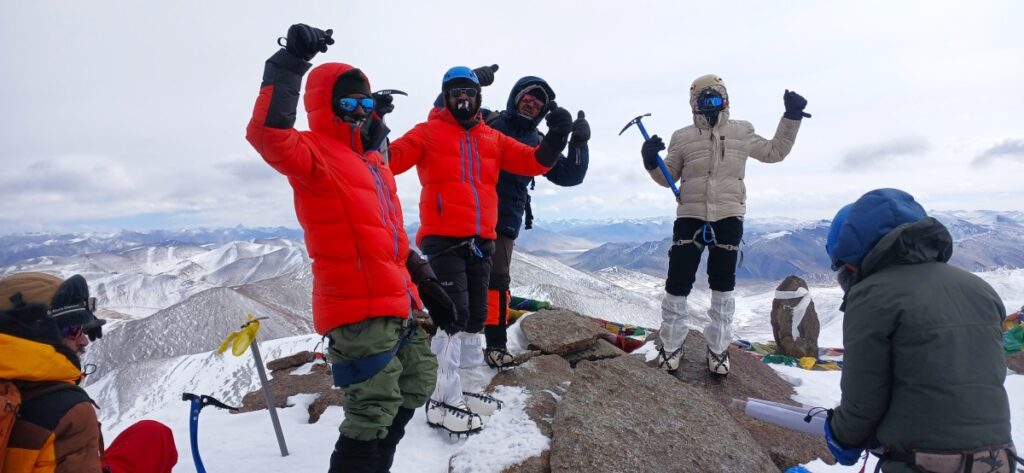
Mingure Acho, who had been trailing the group, came forward and instructed us to rope up. In snow patches riddled with hidden crevasses, being roped together is essential; if one member falls, the others can arrest the slide. Once roped up, we crossed the danger zone and reached a ridge where exposed rock signaled an end to the crevasse risk. By now, it was 11:00 AM. We were moving slowly, as the team was exhausted after seven hours of climbing at extreme altitude. Suddenly, a massive windstorm hit the ridge. Everything turned white; the fog was dense, and the wind whipped snow particles against our faces. The temperature plummeted. For the first time, I felt truly scared. These were the strongest winds I had ever experienced. It was so thick I couldn’t even see the third climber on our rope. It was terrifying and adventurous all at once—a moment I will remember forever. We huddled against the wind, waiting for a break, but at that altitude, late-morning winds rarely stops.
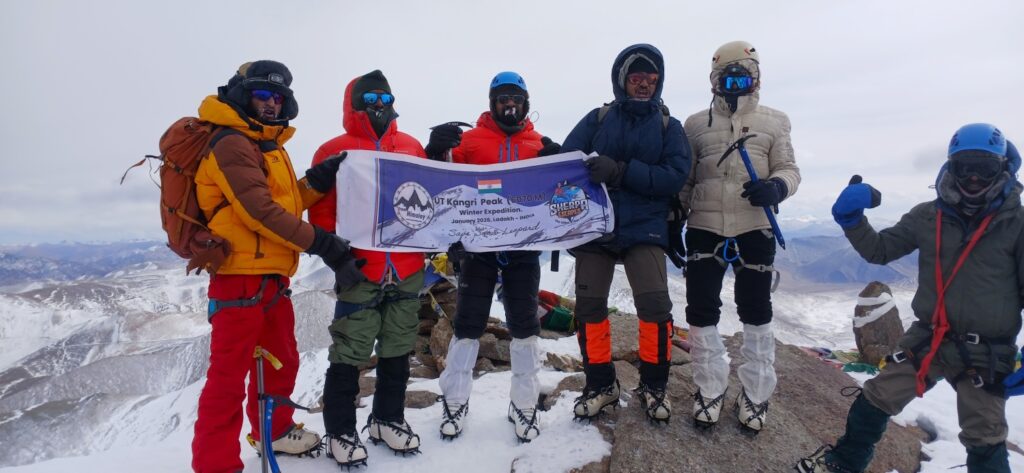
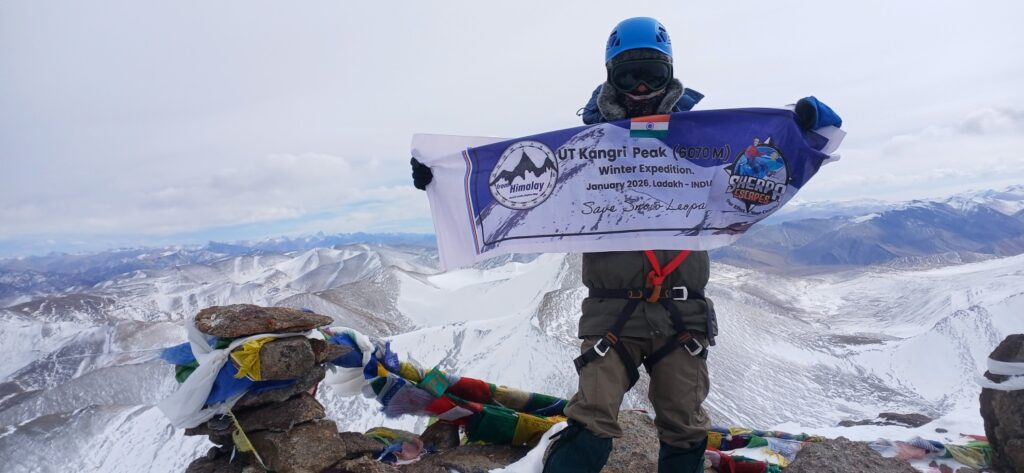
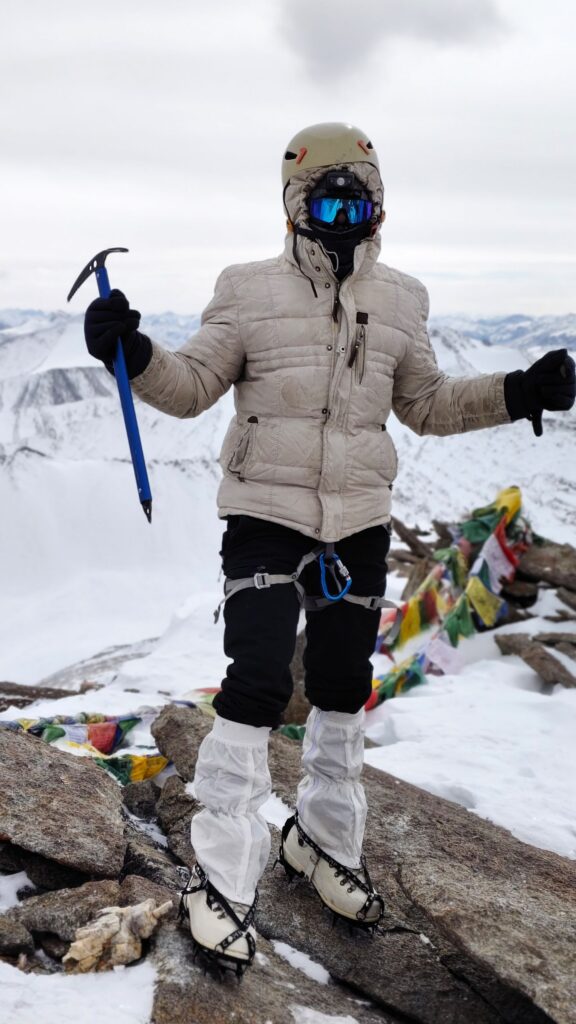
I saw massive dark clouds rolling in from the other side of the peak. A grim thought flashed through my mind: If those clouds reach us before we get back to the crampon point, we’re finished. No one will rescue us until winter is over. I took a deep breath, shook off the fear, and shouted to motivate the team: “Let’s make it to the top quickly and descend safely! We are almost there—let’s move!” I told Rajesh we needed to summit now or turn back immediately. He replied, “It’s just a little further. Let’s make it.” We moved in small intervals when the wind died down. Once we reached a safer area, we detached from the rope, left it on the ridge to lighten our load, and began the final push. My goal was to hit the summit ASAP and get back to the rope for the descent. Finally, I saw the summit flags. They were close, yet in that weather, every meter felt like a mile. I timed my movements with the wind, sprinting upward during the lulls. At 11:54 AM, I finally stepped onto the peak.
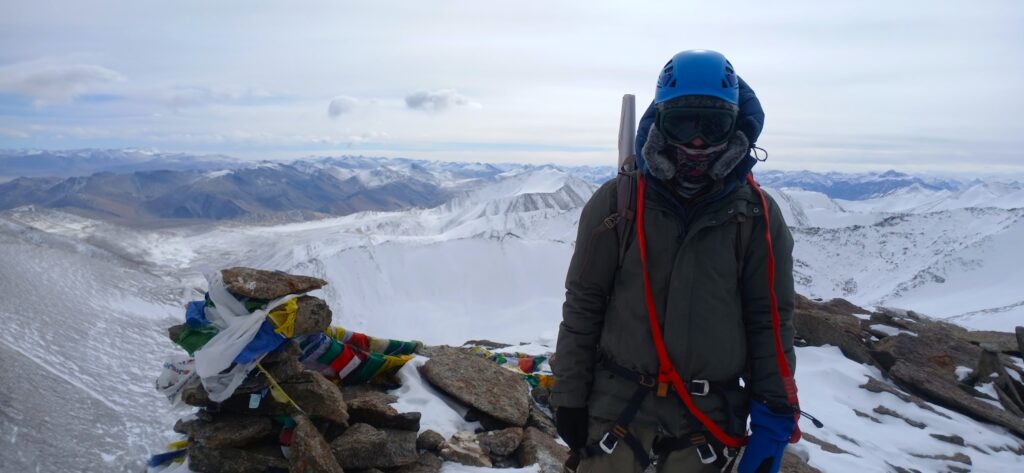
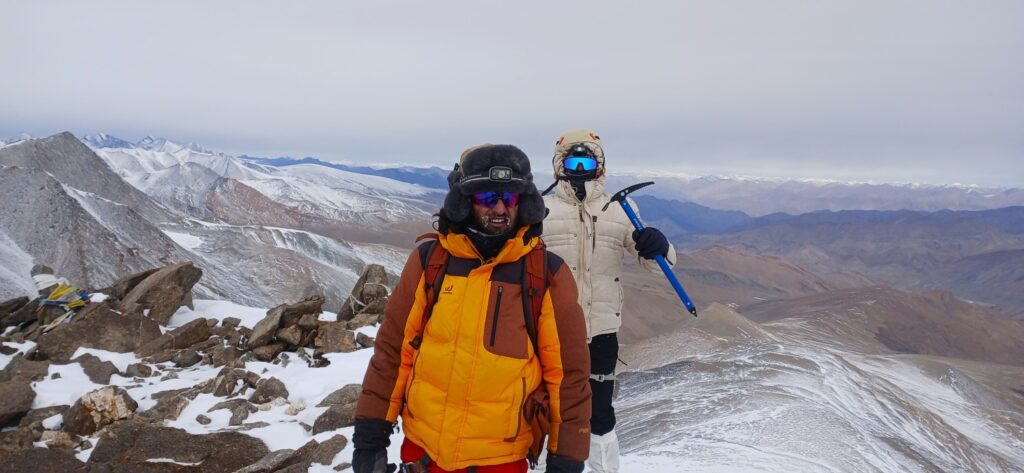
Feeling of standing above the clouds: Standing there, I couldn’t believe I had made it. It was the most satisfying moment of my life. The view was unbelievable—everything was below me, and the wind pushed against me as if telling me I was above the sky. I said a prayer to the mountain and looked out at the 360-degree view, feeling a surge of confidence. I tried to capture a video, but the extreme cold drained my phone battery in a single minute. Twenty minutes later, the rest of the team joined me on top.
Back to the AB and Road
After spending some time at the top, everyone recorded videos and took photos. It was windy and cold, and because we were running late, we couldn’t stay long. I asked everyone to start descending immediately before the weather worsened. Mengure Acho and I stayed at the back to ensure the safety of the members who were tired and exhausted, while the others moved ahead. The descent was easier in terms of physical effort but much riskier. Akhil was walking at the back with me; he was so tired that his beard was frozen and ice had formed over his mouth. He wasn’t able to step properly, so I told him to focus on every single movement since the terrain was so dangerous.
Eventually, the team reached the ridge where we had left the rope during the ascent. Once everyone was clipped back in, I asked Mengure Acho to lead us down a safer route. He followed the ridgeline—it was steep, but safer regarding hidden crevasses. I was at the end of the rope. Some climbers in front of me were moving slowly and slipping repeatedly because they had used up all their energy. I shouted, “Please dig your feet into the snow properly! Otherwise, we’ll all fall off the ridge and die,” knowing there was a drop of thousands of feet on the other side.
After an hour, we finally reached the snowfield below the shoulder of the peak. We detached from the rope, took a break, and finally had some dry food and water, Rajesh and I started walking toward the crampon point. We took off our gaiters and harnesses and packed our bags. The other members were a little slower and reached the point 20 minutes later. Everyone was exhausted, but we had finally reached a safer area. We got ready and started descending toward ABC (Advanced Base Camp).
Rajesh and I descended faster so we could begin packing the bags at camp, while the other members took longer with Mengure Acho leading from the back. After a two-hour descent, we reached the base, drank some water and coffee, and ate some food to regain our energy. It was already 3:00 PM and the others were still far off. After 20 minutes, Rishabh and Hari became visible about 500 meters from base camp, but Deepak and Akhil were still far behind. Rajesh and I decided to continue descending toward the road head. The cars had been waiting for us since 12:00 PM; when we were dropped off, we thought we would be back by noon, but in the mountains, plans don’t always work out. Rishabh and I, and Hari headed down to ensure the cars were still there, while the base camp team stayed behind to load the gear onto horses and bring our climbing buddies down.
After a two-hour trek, we reached the road where the cabs were waiting. We sat inside, and Angochok mentioned they had been waiting a long time. We told them about our day, and they were convinced; he said, “We thought you weren’t coming down today and were about to leave, but then I saw your flashlights and we stopped.” The road point was freezing because it sat on the bank of a frozen river. It was already dark and nearly -28°C. We waited inside the car for the rest of the team to arrive so we could move to Leh. The entire team finally reached us 1.5 hours later. By then, it was 8:00 PM—marking 17 hours of climbing and descending UT Kangri in extreme weather conditions. From the freezing cold of -38°C to the high-speed winds at 19,900 feet, that day in the third week of January in the Ladakh Himalayas is one we will never forget. Our expedition was finally over, and we quickly loaded everything into the cars.
Deepak and Akhil were extremely exhausted. I told them to get into the car quickly, but then Deepak showed me his hands. I was terrified by what I saw; his fingers were in poor condition. The ring, little, and middle fingers on both hands were swollen and filled with fluid—the first signs of frostbite. At the time, I wasn’t sure how deep the damage went. Akhil was also showing symptoms on his toes, and every member of the team was experiencing pain in their fingers, but Deepak’s were the most severely affected. We immediately started the drive to Leh and reached the city around 10:00 PM. Everything was closed in Leh. We checked in at the Leh Palace [hotel], had dinner, and went straight to bed, as we were all completely drained.
We stayed four extra days in Leh because our tickets were booked for January 27th and 28th. We had an amazing time; we tried all the local food, made new friends, and even watched an ice hockey game and the Republic Day parade. After such a wonderful trip, we flew back to Delhi on the 27th. We all returned home with a huge collection of memories and experiences. However, we also have one heartbreaking memory: one of our dear friends suffered a severe cold injury on both of his ring fingers. We all tried our best to prevent it, but unfortunately, it was bad luck. Such incidents can happen with anyone in the mountain in such weather conditions, We are genuinely sorry for him.
Expedition Summary: Winter Ascent
Key Achievement: This team completed the only successful winter ascent recorded after the third week of January. In a rare display of collective strength, every team member reached the summit. The entire expedition was executed with incredible efficiency, spanning only four days and three nights.
Key Takeaways & Mountain Wisdom
1. Strategy and Adaptability
• Flexibility is Mandatory: In the high mountains, plans are merely a starting point. Weather and terrain dictate the terms; you must be prepared for your primary plan to fail and adapt instantly.
• The Fine Line: There is a razor-thin margin between bravery and stupidity. Success is found in knowing when to push and when to respect the mountain’s power.
2. Physical Preservation
• Energy Management: Rest is a resource, not a luxury. Never waste energy on unnecessary tasks; always prioritize recovery to maintain your peak performance.
• Prevention Over Cure: It is far easier to prevent an injury or altitude issue than it is to treat one in a high-altitude environment.
3. Thermal Discipline
• Layering Essentials: Never leave your skin exposed. Use a sophisticated layering system—specifically a high-quality inner and outer glove combination—to keep fingers functional and warm.
• The Golden Rule: Stay warm and stay dry. Moisture is the enemy of survival in sub-zero temperatures.
Expedition Gallery
Watch YouTube Video